DARPA Grand Challenge: driverless cars in the desert
No vehicle finished DARPA’s first Grand Challenge in 2004. In 2005, five teams completed the course and Stanford’s Stanley won. These were defined desert routes, not demonstrations of unrestricted autonomous driving.
The image could not load. You can open its source from the caption.
Stanley photographed on 15 January 2006 at the North American International Auto Show. The Stanford Racing Team vehicle won the 2005 DARPA Grand Challenge. The image shows the real vehicle at a later exhibition, not the winning moment or the desert run. · Global Reactions · Flickr / Wikimedia Commons · CC BY 2.0 · Image source · Object documentationSupporting curatorial card
A Museum graphic supporting the explanation of this exhibit.
Curatorial document card · based on results published by DARPA · contains no photographs of the vehicles · Independent Digital Museum of Artificial Intelligence · curatorial graphic · 2026 · Original Independent Digital Museum of Artificial Intelligence card. No photograph, video or logo of DARPA or the teams is reproduced.
Why it is in the museum
Machine learning changes the problem: instead of writing every rule, we provide data and examples. Their gaps and biases can pass into the model too.
The story of the exhibit
DARPA, the US Department of Defense’s advanced research projects agency, launched the Grand Challenge to speed up the development of autonomous vehicles, with military uses in mind. On 13 March 2004 the vehicles set off from near Barstow, California, heading for Primm, Nevada. None came close to the finish. The vehicle that went furthest, Carnegie Mellon University’s Sandstorm, stopped on a rock after about 12 kilometres. The one-million-dollar prize went unclaimed.
Nineteen months later, on 8 October 2005, the picture had changed. Five vehicles completed a 132-mile route, about 212 kilometres, through the desert near the California–Nevada state line. First across the line was Stanley, built by Sebastian Thrun’s team at Stanford, in just under seven hours. It won the two-million-dollar prize. The Urban Challenge followed in 2007, this time in an urban setting.
The Stanford team described Stanley in a 2006 article in the Journal of Field Robotics. It states that the robot’s software relied mainly on machine learning and probabilistic reasoning. Instead of writing rules for every kind of terrain, the system used learning from data, including in its computer vision, to tell road it could drive on from ground it had to avoid.
Two races at a glance
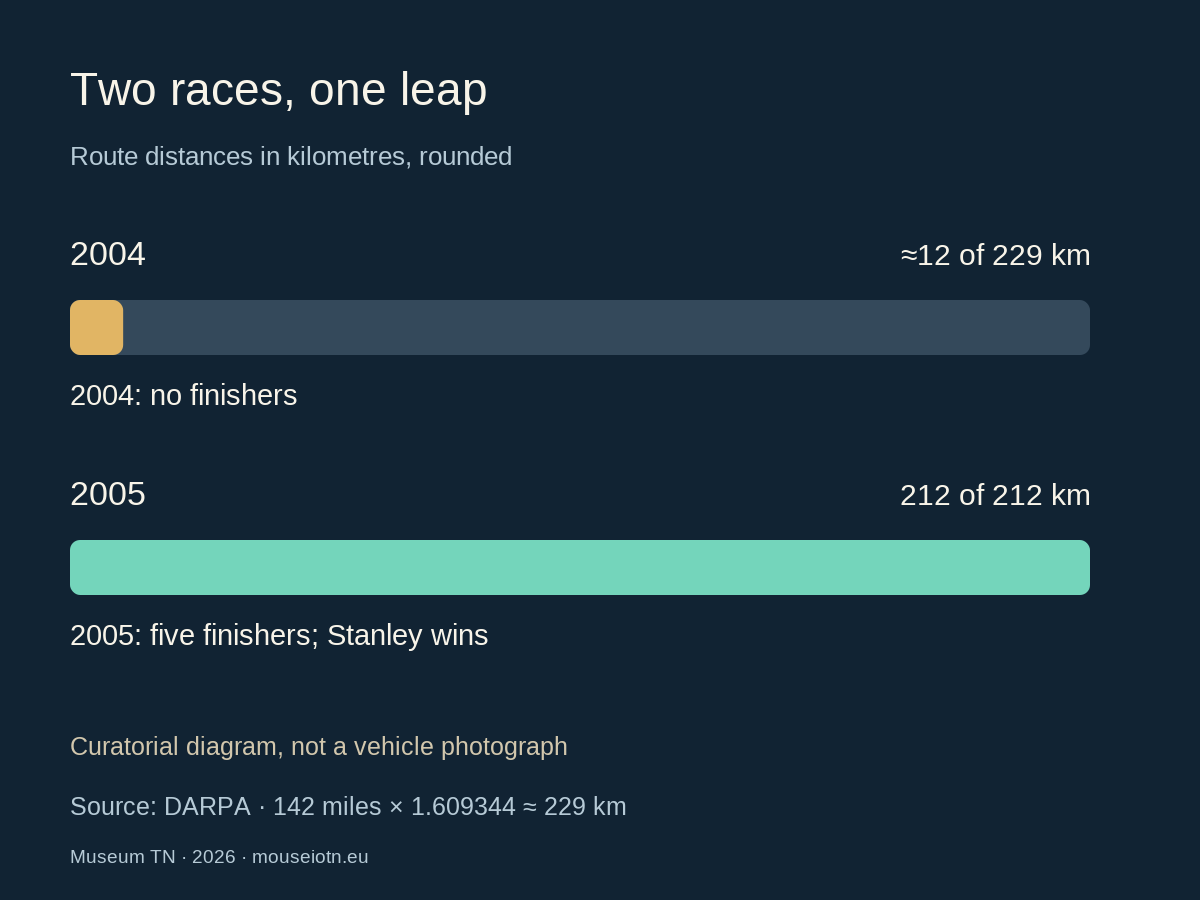
The bars show how much of the route the best vehicle covered in each race. Distances are rounded.
2004 · Barstow–Primm≈12 of 229 km
No finishers. Best: Sandstorm (Carnegie Mellon).
2005 · California–Nevada desert212 of 212 km
Five finishers. Winner: Stanley (Stanford), in under 7 hours.
Sources: DARPA, Innovation Timeline; Thrun et al. 2006. The 2004 route was 142 miles (about 229 km).
Evidence and interpretation
DARPA’s page documents the dates, routes, prizes and results of both races, and the team’s publication documents Stanley’s architecture. Sandstorm’s distance (11.78 km) and the winner’s exact time differ slightly between sources.
The race did not solve autonomous driving. The desert had no pedestrians, traffic lights or other drivers. The Independent Digital Museum of Artificial Intelligence shows it in the room on learning because it shows how quickly a result can change when a machine learns from data instead of following hand-written rules alone. DARPA credits the races with creating a research community. How much they contributed to today’s autonomous vehicles is a matter of interpretation.
What supports this exhibit
Institutional source and scientific publication
The dates, routes, prizes and results of the 2004 and 2005 races, and the role of machine learning and probabilistic reasoning in Stanley.
Main source: DARPA, “The Grand Challenge”, Innovation Timeline. Thrun, S., Montemerlo, M. et al. (2006), “Stanley: The Robot that Won the DARPA Grand Challenge”, Journal of Field Robotics 23(9), pp. 661–692.
What to keep in mind: DARPA organised the races, so the source is institutional. Their role in the later industry is interpretation, not a measurable fact.
Full documentation
Permanent accession ID
MTN-0073
Exhibition position
3.5
Title
DARPA Grand Challenge: driverless cars in the desert
Date
2004–2005
Creator / responsible institution
DARPA (Defense Advanced Research Projects Agency) · winning team: Stanford Racing Team
Evidence type
Institutional source and scientific publication
Original / reproduction status
Photograph of the real autonomous vehicle Stanley
Provenance / custody history
A Global Reactions photograph on Flickr, with CC BY 2.0 confirmed on transfer to Commons. The vehicle’s identity and its 2005 victory are cross-checked against the Stanford Racing Team archive. Independent Digital Museum of Artificial Intelligence does not claim ownership of the vehicle.
Primary documentary source
DARPA, “The Grand Challenge”, Innovation Timeline. Thrun, S., Montemerlo, M. et al. (2006), “Stanley: The Robot that Won the DARPA Grand Challenge”, Journal of Field Robotics 23(9), pp. 661–692.
Image rights
Global Reactions · Flickr / Wikimedia Commons · CC BY 2.0 · https://commons.wikimedia.org/wiki/File:Stanford_Volkswagon_Touareg_Robotic_Control_Vehicle_(86757864).jpg
Certainty
Claim-level certainty has not yet been reviewed.
Last curatorial review
2026-10-11
Next review
2027-10-16
Visual documentation review
2026-10-12 · v7.85.5
Relationships to other exhibits
Linked to: 9.2 AI gets a body: from the desert race to today’s robotic systems
Linked from: 3.2 ImageNet: data and learning instead of hand-written rules
This record separates the evidence from its visual representation and records provenance, rights and curatorial relationships.
What is documented and what remains interpretive
Documented
On 13 March 2004, none of the 15 finalist autonomous vehicles completed the designated course.
The existing caption preserves the recorded image attribution. Its licence was not independently reverified in this phase. No AI generation or editing by the museum is recorded; this does not establish the absence of other processing.
AI conversation
The exact version of the live response model was not confirmed. Limiting sources does not guarantee the accuracy of every reply. Human expert validation of every generated response is not documented.
Scope of review
Selected claims were reviewed against published sources and local code. This is not independent scientific or legal certification.
Citation & editorial transparency
Suggested citation
Independent Digital Museum of Artificial Intelligence. (2026). “DARPA Grand Challenge: driverless cars in the desert”. https://www.mouseiotn.eu/en/exhibits/darpa-grand-challenge-2004-2005/
The suggested questions open curated extracts. You can also submit a question when the live service is available.
The exhibit’s “voice” is a curatorial reconstruction, not an authentic statement or actual consciousness. Documented fact, interpretation, reconstruction and uncertainty remain distinct.
Preset questions use the exhibit record in your browser. If you submit a free-text question, its text, the exhibit ID and language go to the museum API and may be forwarded to an external AI provider. Answers can contain errors. Do not enter personal information. Privacy.