Exhibit 9.11
Level of certainty:Already happening
2026 →Who made this image?
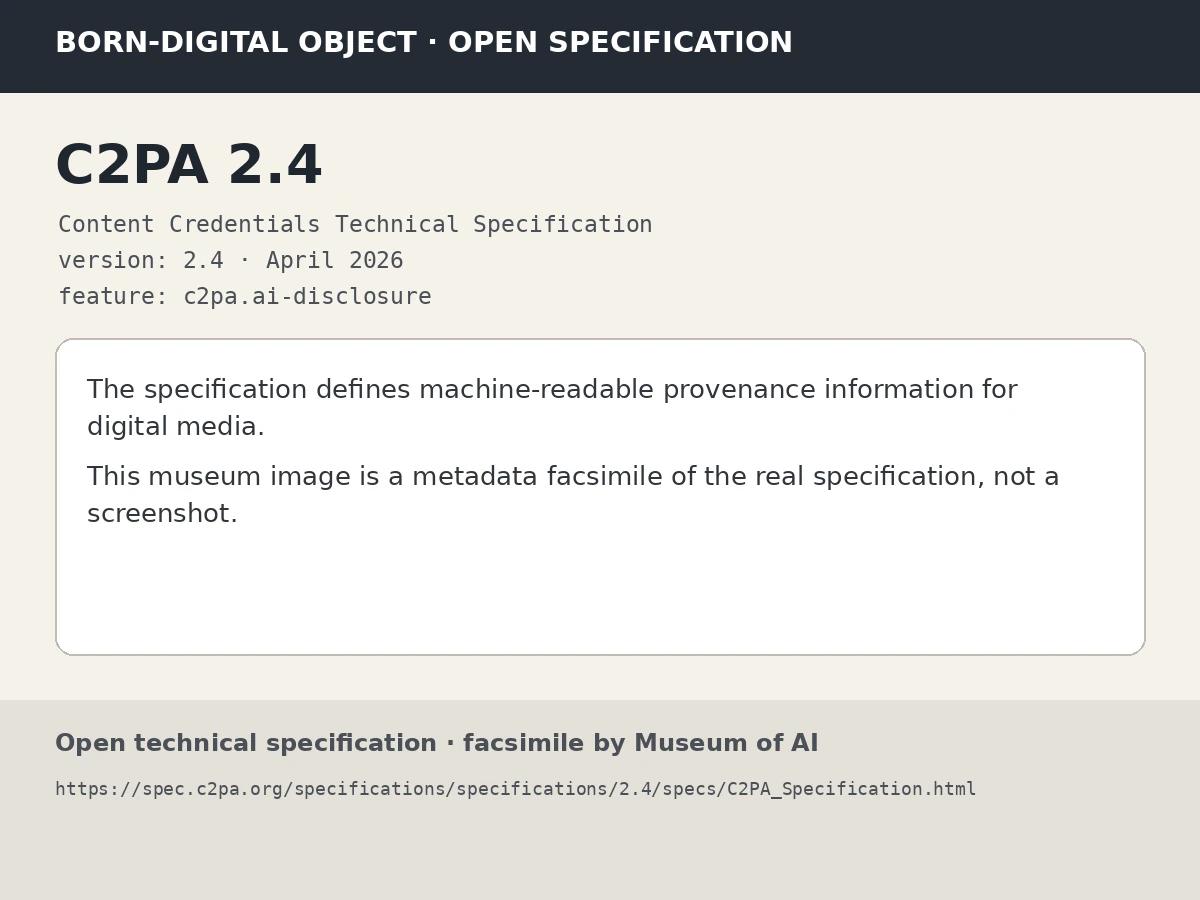
C2PA specification 2.4 defines provenance credentials, including structured disclosure of AI involvement in digital content.
Curatorial update: 26 November 2026
Research update
The C2PA specification describes how signed information about origin and edits can be associated with a file. A valid signature does not prove that the depicted event is true. Missing credentials do not necessarily make an image false. Usage rights must be checked separately.
C2PA Technical Specification 2.4, April 2026 · Read the source
Status as of 16 October 2026 · Next review: 2027-01-16
Interactive provenance lab
Build and break a provenance chain
Change which declarations travel with a hypothetical digital file and see what a verifier can conclude. This is not a real C2PA validator.
Path: capture → crop → AI edit → export.
You decide which steps are declared and whether credentials survive in the final file.
Teaching simulation: the nodes are not real C2PA signatures and no cryptographic verification occurs. The exhibit shows the logic of provenance, declared edits and AI disclosure. Complete provenance is not proof that the content is true.
Why it is in the museum
Digital-content authenticity becomes a central issue as generative AI lowers the cost of producing convincing synthetic images, audio and video.
What supports this exhibit
Open technical standard / born-digital specification
The existence of a technical mechanism for cryptographically verifiable provenance and a dedicated AI-disclosure assertion.
Main source: C2PA, Content Credentials Technical Specification 2.4 (April 2026).
What to keep in mind: Content Credentials can document provenance and declared changes when correctly used; they do not by themselves prove that content is true.
Full documentation
- Permanent accession ID
- MTN-0063
- Exhibition position
- 9.11
- Title
- Who made this image?
- Date
- 2026 →
- Creator / responsible institution
- C2PA
- Evidence type
- Open technical standard / born-digital specification
- Original / reproduction status
- Born-digital primary object · open technical specification / metadata facsimile
- Provenance / custody history
- Contemporary born-digital document. Its identity and provenance are documented by the institution or authors named in the primary source. The Independent Digital Museum of Artificial Intelligence documents and links the source without claiming ownership of the original.
- Primary documentary source
- C2PA, Content Credentials Technical Specification 2.4 (April 2026).
- Image rights
- Facsimile: Independent Digital Museum of Artificial Intelligence CC BY-SA 4.0 · underlying record: C2PA Technical Specification 2.4
- Certainty
- Already happening
- Last curatorial review
- 2026-10-10
- Next review
- 2027-01-16
- Visual documentation review
- 2026-10-12 · v7.85.4
Relationships to other exhibits
- 7.1 Deepfakes: deepfakes make provenance and verification critical
- 9.9 More AI, more rules: transparency rules need technical mechanisms for implementation
This record separates the evidence from its visual representation and records provenance, rights and curatorial relationships.
Citation & editorial transparency
Suggested citation
Independent Digital Museum of Artificial Intelligence. (2026). «Who made this image?». https://www.mouseiotn.eu/en/exhibits/who-made-this-image/Follow the thread
Continue from here
The collection is not a set of isolated pages. See how this object connects to what came before or after.
Interactive exhibit
Talk to the exhibit
The suggested questions open curated extracts. You can also submit a question when the live service is available.
The exhibit’s “voice” is a curatorial reconstruction, not an authentic statement or actual consciousness. Documented fact, interpretation, reconstruction and uncertainty remain distinct.
Preset questions use the exhibit record in your browser. If you submit a free-text question, its text, the exhibit ID and language go to the museum API and may be forwarded to an external AI provider. Answers can contain errors. Do not enter personal information. Privacy.