Museum of AI · For schools · Educational route
Artificial Intelligence and Biology
Two exhibits, one question: what can a machine do to help us understand life better? Students train a classifier with photographs of Greek nature and follow insulin from DNA to the shape predicted by AlphaFold.
This route is a proposal by the Museum of AI for Biology lessons. It has not been approved by the Greek Institute of Educational Policy (IEP). Links to school books are based on the official Greek teaching guidelines for the 2026–2027 school year.
Both exhibits run inside the browser. They need no account and send no answers to a server. If a student adds a photo of their own, it stays on the device.
The two stops
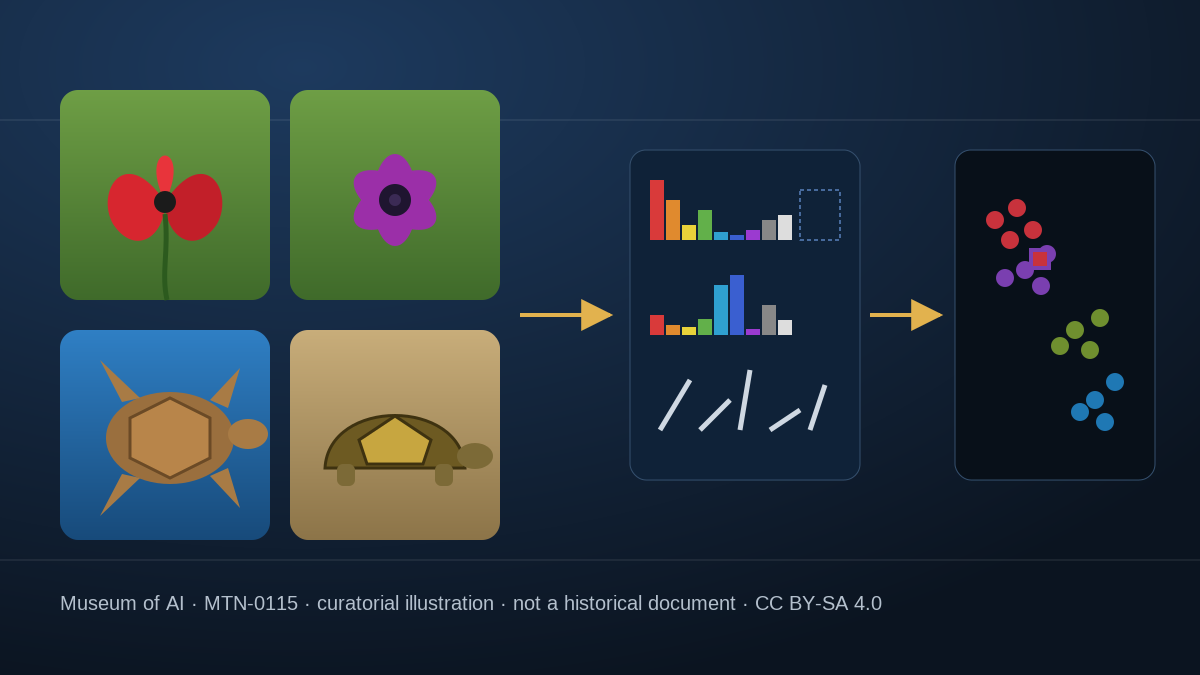
An image classifier with real photographs from Greece. Training and test sets, mistakes and limits.
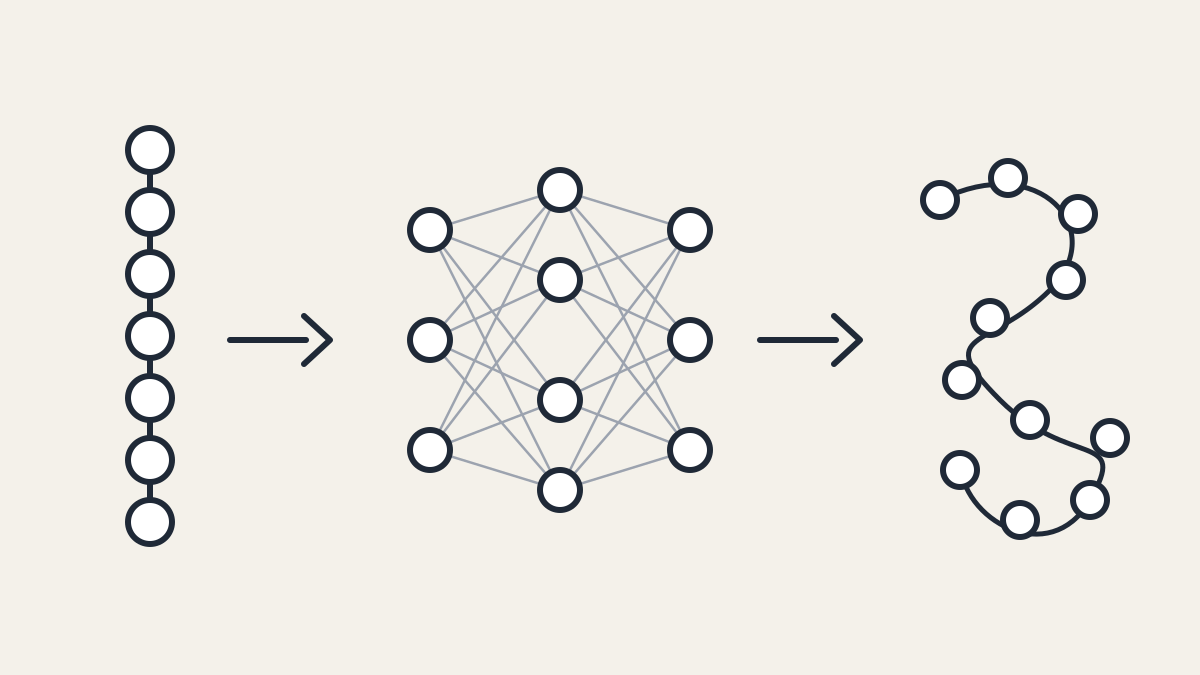
Seven stages with real data: DNA, transcription, translation, chain, folding, AlphaFold prediction and comparison with experiment.
Lower secondary (ages 12–15)
Topics
- Diversity of organisms
- Biological classification
- The molecules of life
- Introduction to DNA and proteins
- Pattern recognition by machines
Learning objectives
- Describe in their own words how information in DNA leads to a protein (DNA, RNA, protein).
- Recognise that A pairs with T and G with C, and that the ribosome reads triplets of letters.
- Explain that a protein’s shape is linked to its function.
- Distinguish biological classification (relationship) from machine image recognition (appearance).
- Explain why a classifier is tested with data it has not seen.
- State one limit of artificial intelligence based on what they observed.
45-minute lesson plan
| Time | Phase | Activity |
|---|---|---|
| 0–5′ | Opening | Show a photo of a poppy and one of an anemone. “Are they related plants? Would a machine tell them apart?” Students answer the pre-visit questions. |
| 5–20′ | Exhibit 3.9 | In pairs: steps 1 to 4. They label, train and test, and note the accuracy on the worksheet. |
| 20–35′ | Exhibit 4.6 | Stages 1 to 4 and 6: find ATG, help the polymerase, translate the first codons and look at AlphaFold’s confidence colours. |
| 35–42′ | Discussion | What does the machine do well? Where does it need people? Link to biological classification. |
| 42–45′ | Reflection | Post-visit questions and a short quiz. |
Notes for the teacher
- With few devices, project the exhibits on an interactive board and let groups give the answers.
- In the “Labels” step let one pair add a deliberately wrong label. Compare the results afterwards.
- Stress that the folding movement is an educational representation, not the real pathway.
- For students with learning difficulties: use only stages 1 to 3 and step 4 of the classifier. Buttons are large and work with the keyboard.
- Photos and molecular structures load from the internet when there is no local copy. Check the connection before the lesson.
Before the visit
- What do you think is inside DNA?
- Can a computer understand what a flower is? Why?
- Are two organisms that look alike always related?
After the visit
- What are the three steps from DNA to protein?
- Why did the classifier confuse some photos?
- What do blue and orange mean in the AlphaFold model?
Worksheet
Artificial Intelligence and Biology · Lower secondary (ages 12–15) · Worksheet
- Write the partner of each letter: A – ___ , G – ___ , T – ___ , C – ___
- The triplet where the insulin instruction starts is: ________
- In RNA, which letter takes the place of T? ________
- Accuracy of my classifier in the first test: _____ %. After adding data: _____ %
- Which two species were confused most often? Write one possible explanation.
- Do the poppy and the anemone belong to the same family? Yes / No. Where did you find out?
- Draw or describe in one sentence what AlphaFold predicts.
Interactive quiz
Group task
Group task: “The review panel”
Each group takes a role: biologist, programmer, nature photographer, iNaturalist volunteer. Using the classifier’s results, each role proposes one change that would improve recognition (more photos, other seasons, correct labels, different backgrounds). The class decides which change to try first in step 6 and checks whether the accuracy changed.
Suggested answers for the teacher
- A–T, G–C, T–A, C–G.
- ATG (in RNA: AUG).
- U (uracil).
- It depends on the class. With few photos the accuracy changes a lot from test to test.
- The two red flowers are often confused, because the classifier sees colour, not relationship. The background matters too.
- No. Papaveraceae and Ranunculaceae (step 1 of exhibit 3.9).
- The three-dimensional position of a protein’s atoms from its amino acid sequence, with a confidence score.
Links to Greek school books
Sections according to the Greek 2026–2027 teaching guidelines. The books are available on the Interactive School Books platform (in Greek).
- Βιολογία Α΄ Γυμνασίου (Μαυρικάκη, Γκούβρα, Καμπούρη) · 1.1 Τα χαρακτηριστικά των οργανισμών · Δραστηριότητα 1.5 «Κατάταξη και ταξινόμηση των οργανισμών» · Open the exhibit
- Βιολογία Β΄ & Γ΄ Γυμνασίου (Μαυρικάκη, Γκούβρα, Καμπούρη) · Γ΄ Γυμνασίου · 1.1 Τα μόρια της ζωής · Open the exhibit
- Βιολογία Β΄ & Γ΄ Γυμνασίου · Γ΄ Γυμνασίου · 5.2 Ροή γενετικής πληροφορίας · Open the exhibit
- Βιολογία Β΄ & Γ΄ Γυμνασίου · Γ΄ Γυμνασίου · 5.6 Μεταλλάξεις · Open the exhibit
- Βιολογία Β΄ & Γ΄ Γυμνασίου · Γ΄ Γυμνασίου · 7.1 Η εξέλιξη και οι μαρτυρίες της · Open the exhibit
Official syllabus sources (in Greek)
- Εγκύκλιος 111939/Δ2/2026 · Οδηγίες διδασκαλίας Βιολογίας Γυμνασίου 2026–2027 (εισήγηση ΙΕΠ, πράξη 63/30-07-2026)
- Ύλη και οδηγίες διδασκαλίας Βιολογίας Α΄ Γυμνασίου 2026–2027 (PDF)
- Ύλη και οδηγίες διδασκαλίας Βιολογίας Γ΄ Γυμνασίου 2026–2027 (PDF)
- Διαδραστικά Σχολικά Βιβλία (ebooks.edu.gr)
- Φωτόδεντρο · «Τα χημικά συστατικά της ζωής»
Upper secondary (ages 15–18)
Topics
- The central dogma of molecular biology
- Primary, secondary, tertiary and quaternary protein structure
- Structure and function
- Mutations and their possible effects on proteins
- Bioinformatics
- Machine learning and scientific verification
Learning objectives
- Describe the flow of genetic information and explain why the template strand is transcribed.
- Predict the effect of point mutations (silent, missense, nonsense) using the genetic code.
- Distinguish the four levels of structure with examples from insulin and haemoglobin.
- Link structure and function (haem in myoglobin, lysozyme active site, disulfide bonds in insulin).
- Interpret pLDDT and RMSD and explain why a prediction needs experimental checking.
- Explain the difference between training and test data and identify sources of error in a machine learning model.
45-minute lesson plan
| Time | Phase | Activity |
|---|---|---|
| 0–5′ | Opening | Question: “AlphaFold won a Nobel Prize. Does that mean we no longer need experiments?” Pre-visit questions. |
| 5–22′ | Exhibit 4.6 | Groups of three: stages 2 to 4 with a mutation in stage 3, then stages 6 and 7. They record pLDDT and RMSD for insulin and haemoglobin. |
| 22–35′ | Exhibit 3.9 | Steps 2 to 6. First training with few photos, then with more. They compare the confusion matrices. |
| 35–42′ | Scientific verification | Discussion: prediction, experiment and uncertainty in both exhibits. When do we trust a model? |
| 42–45′ | Reflection | Post-visit questions and quiz. |
Notes for the teacher
- The Greek 2026–2027 syllabus for the final year does not name the four levels of structure separately. Use them as enrichment on the textbook subsection about proteins.
- In stage 3 ask for one silent, one missense and one nonsense mutation. The experience does not predict a new structure after the mutation, which is a good point for discussion.
- In stage 7 explain that the preproinsulin model contains the signal peptide and the C-peptide, while the crystal structure shows only chains A and B.
- The classifier is k nearest neighbours with simple features. Compare it with the deep neural networks of exhibit 4.3 AlexNet.
- RMSD and accuracy are calculated on the device at that moment. They may differ slightly between groups if the data changed.
Before the visit
- What is the relationship between a gene and a protein?
- How is the structure of a protein determined experimentally?
- What does it mean for a machine learning model to “generalise”?
After the visit
- Why does AlphaFold’s prediction for preproinsulin differ from mature insulin?
- How does a nonsense mutation affect the size of the protein?
- Give an example where artificial intelligence needs human or experimental checking.
Worksheet
Artificial Intelligence and Biology · Upper secondary (ages 15–18) · Worksheet
- Codon 4 of insulin is UGG. If it becomes UAG, what happens? What kind of mutation is it?
- Codon 25 (UUU) becomes UUC. What changes in the protein and why?
- Give one example for each level of structure from what you saw: primary, secondary, tertiary, quaternary.
- pLDDT of the B chain: about ___ · pLDDT of the C-peptide: about ___. What does the difference mean?
- Insulin RMSD: ___ Å over ___ amino acids. Haemoglobin RMSD: ___ Å. Which comparison shows better agreement?
- Why does the AlphaFold model of myoglobin have no haem? What does that mean for function?
- Classifier accuracy with 16 photos: ___ %. With 48: ___ %. Is the difference reliable with 24 test photos? Explain.
Interactive quiz
Group task
Group task: “Reviewing a prediction”
Each group chooses one of the four proteins. It collects pLDDT, RMSD and the comparison result and prepares a two-minute “scientific report”: what was predicted, what the experiment measured, where they differ and what uncertainty remains. The class compares the reports with the image classifier results: what limits do the two models share?
Suggested answers for the teacher
- A stop codon appears. The chain stops after 3 amino acids. Nonsense mutation.
- Nothing. UUC also gives phenylalanine. Silent mutation, because the genetic code is degenerate.
- Primary: the order of the 110 amino acids. Secondary: the α-helices. Tertiary: the shape of myoglobin. Quaternary: the four chains of haemoglobin (4HHB).
- The B chain has high pLDDT and the C-peptide very low. The C-peptide has no fixed structure in the model and is absent from mature insulin.
- Values are calculated on the device. Lower RMSD means better agreement.
- AlphaFold DB gives only the protein chain, without ligands. Haem is needed to bind oxygen, so the model does not show the whole functional unit.
- With 24 test photos one photo changes the accuracy by about 4 percentage points. Small differences are not reliable.
Links to Greek school books
Sections according to the Greek 2026–2027 teaching guidelines. The books are available on the Interactive School Books platform (in Greek).
- Βιολογία Γενικής Παιδείας Β΄ Γενικού Λυκείου · 3.1.1 Ταξινόμηση των οργανισμών και εξέλιξη · 3.3 Φυλογένεση · Open the exhibit
- Βιολογία Γ΄ ΓΕΛ, Τεύχος Α΄ (Καψάλης κ.ά.) · 1.2 Μακρομόρια · «Πρωτεΐνες: Διαδεδομένες, πολύπλοκες και εύθραυστες» · Open the exhibit
- Βιολογία Γ΄ ΓΕΛ, Τεύχος Β΄ (Αλεπόρου-Μαρίνου κ.ά.) · Κεφ. 1 Το γενετικό υλικό · Κεφ. 2 Αντιγραφή, έκφραση και ρύθμιση της γενετικής πληροφορίας · Open the exhibit
- Βιολογία Γ΄ ΓΕΛ, Τεύχος Β΄ · Κεφ. 6 Μεταλλάξεις · Open the exhibit
- Βιολογία Γ΄ ΓΕΛ, Τεύχος Β΄ · Κεφ. 4 Τεχνολογία του ανασυνδυασμένου DNA · Κεφ. 8 Εφαρμογές της Βιοτεχνολογίας στην Ιατρική · Open the exhibit
Official syllabus sources (in Greek)
For teachers who want to go further: EMBL runs a free “Protein folding and AI” course for secondary science teachers (1–3 March 2027, Heidelberg, applications until 11 January 2027). EMBL