Exhibit 3.9 · MTN-0115
2017–2026Can a Machine Recognise Nature?
Since 2017 iNaturalist has suggested plant and animal species from photographs using computer vision. Here you train a small classifier with real photographs of Greek nature and see where it succeeds and where it gets confused.
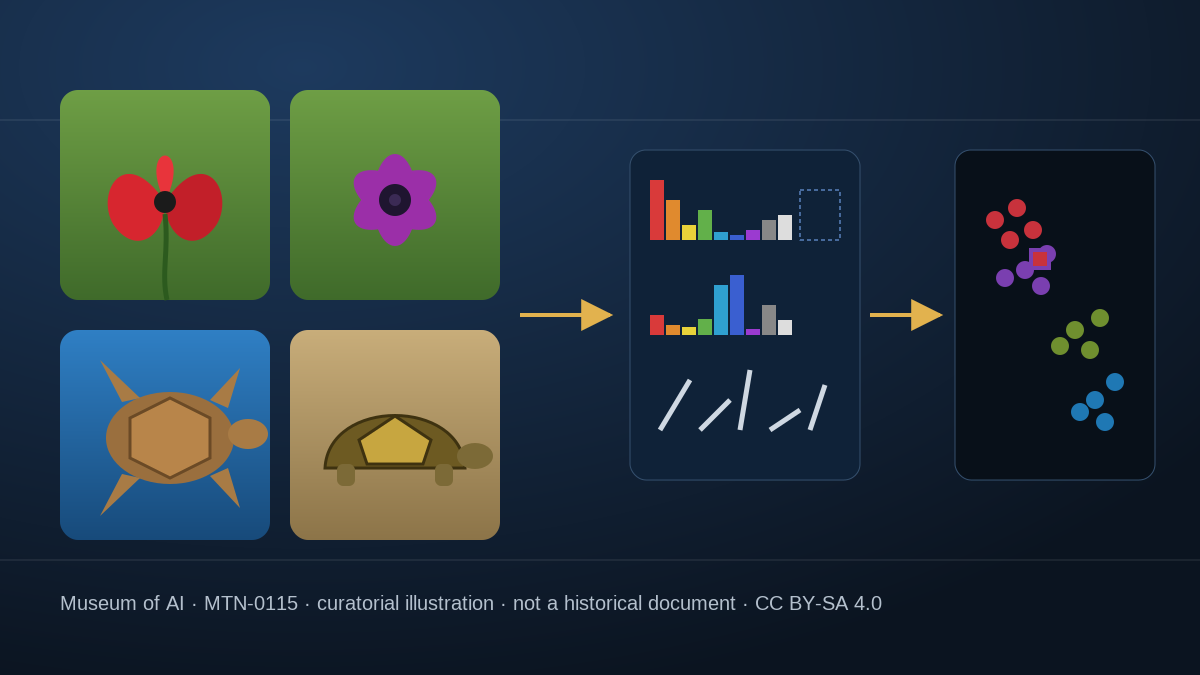
Interactive machine learning experiment
Can a Machine Recognise Nature?
Since 2017 iNaturalist has suggested plant and animal species from photographs using computer vision. Here you train a small classifier with real photographs of Greek nature and see where it succeeds and where it gets confused.
The experiment in text
The experiment needs JavaScript. If it does not load, the exhibit text below describes every step.
- Meet four species: common poppy, poppy anemone, loggerhead sea turtle and Hermann’s tortoise, with their classification.
- Label the training photographs.
- The classifier turns each photo into 41 numbers for colour and edges.
- Test with 24 photos that were not used in training and see the accuracy and confusion matrix.
- Examine the mistakes and the closest training photos.
- Add more data or your own and compare the accuracy.
- Compare biological classification with image recognition.
Three reading levels
In one sentence
A machine can learn to tell organisms apart from photographs, but it sees only pixels, not kinship.
Summary
Species identification apps take a photograph and suggest the name of a plant or animal. iNaturalist, an international platform where volunteers record observations of nature, has used such models since 2017. Its team reports that the first model knew about 13,000 species. The models learn from photographs that people have identified. This exhibit gives you a much smaller classifier and four species from Greek nature. You add labels, train, test with photographs the classifier has never seen and compare the way it “sees” with biological classification.
Full exhibit ↓
Why it is in the museum
Recognising patterns is one of the abilities people try to pass on to machines. In biology, recognising a species is often the first step towards studying and protecting it. The exhibit shows what a machine does well and what it cannot do on its own.
The historical starting point
On iNaturalist users upload photographs of organisms and other users confirm the species. In December 2017 the team wrote that, about six months earlier, it had switched on species suggestions based on computer vision. The same year researchers working with the iNaturalist team published the iNat2017 dataset, with photographs of thousands of species, for research on species recognition (Van Horn and colleagues).
What the Museum’s classifier does
The classifier you use is not a neural network. It turns each photograph into 41 numbers: the colours in the centre, the colours around the edges and the direction of the edges. For a new photograph it finds the most similar training photographs and lets them vote. The method is called “k nearest neighbours”. The test photographs are always kept apart from training, so that the accuracy measures something real.
Biological classification and image recognition
The common poppy (Papaver rhoeas) and the poppy anemone (Anemone coronaria) are red flowers from different families, Papaveraceae and Ranunculaceae. The loggerhead (Caretta caretta) and Hermann’s tortoise (Testudo hermanni) belong to the same order, but one lives in the sea and the other on land. Biological classification groups by relationship. The classifier groups by what the pixels look like and may learn the background instead of the organism.
What we do not know
We do not know how well the classifier would work with photographs from other regions, seasons or cameras. With 24 test photographs the accuracy changes noticeably from one test to the next. Large models are far more accurate, but they also make mistakes, especially for species with few photographs. On iNaturalist an observation becomes “research grade” only when people agree on the species.
The Museum’s interpretation
This part is curatorial interpretation. The machine does not “understand” nature. It finds regularities in the data we give it, and its quality depends on that data and on the labels people provide. That is why the exhibit stands in Room 3, next to ImageNet: the data are part of the model.
Sources and documentation
Interactive digital exhibit · educational reconstruction
- iNaturalist, «Vision suggestion updates» (Δεκ. 2017)
- iNaturalist, «We’re now modeling over 80,000 taxa! A conversation with Alex Shepard»
- Van Horn, G. et al. (2018), «The iNaturalist Species Classification and Detection Dataset», CVPR · arXiv:1707.06642
- GBIF, iNaturalist Research-grade Observations (dataset 50c9509d-22c7-4a22-a47d-8c48425ef4a7)
Part of the educational route “Artificial Intelligence and Biology”.
Full documentation
What we know and how certain it is
- Documented
In December 2017 iNaturalist reported that it had switched on computer-vision species suggestions about six months earlier.
- Documented
According to an interview with Alex Shepard on the iNaturalist blog, the first model of 2017 contained about 13,000 species.
iNaturalist, «We’re now modeling over 80,000 taxa! A conversation with Alex Shepard»
- Documented
The iNat2017 dataset was presented by Van Horn and colleagues (arXiv 2017, CVPR 2018).
- Permanent accession number
- MTN-0115
- Position in the exhibition
- 3.9
- Title
- Can a Machine Recognise Nature?
- Date
- 2017–2026
- Creator / responsible body
- Museum of AI (experiment) · historical starting point: iNaturalist
- Type of evidence
- Interactive digital exhibit · educational reconstruction
- Original / reproduction status
- No iNaturalist system is reproduced. Openly licensed photographs are shown at reduced size.
- Provenance
- Photographs from research-grade iNaturalist observations in Greece, as published on GBIF. The classifier is original code by the Museum.
- Main documentary source
- iNaturalist, «Vision suggestion updates» (Δεκ. 2017) · Van Horn, G. et al. (2018), «The iNaturalist Species Classification and Detection Dataset», CVPR · arXiv:1707.06642
- Image rights
- Exhibit image: original curatorial illustration by the Museum of AI, CC BY-SA 4.0. Photographs: CC BY 4.0 or CC BY-SA 4.0, author shown on each photo.
- Certainty
- Documented claim by claim
- Last curatorial review
- 2026-11-25
- Next review
- 2027-05-25
Relations with other exhibits
- 3.2 ImageNet: labelled data as the basis of image recognition
- 3.1 The term “machine learning”: learning from examples
- 4.3 AlexNet: the deep networks used by today’s recognition apps
- 4.6 AlphaFold: Artificial Intelligence and Biology: the second stop of the educational route