Exhibit 1.4
1958 · paperThe perceptron
Frank Rosenblatt’s perceptron was an early model whose connections could be adjusted from examples. The 1958 paper and the later experimental apparatus are distinct historical records.
The idea in one sentence
In 1958 Frank Rosenblatt described a machine that is not programmed for each shape but corrects its connections every time it makes a mistake.
Summary
In 1958 Frank Rosenblatt, a psychologist at the Cornell Aeronautical Laboratory, published “The perceptron” in Psychological Review. He proposed a network in three layers: sensory units that receive an image, association units randomly connected to them, and response units that give the answer. The novelty lay in the last step. The connections to the response change when the system answers wrongly. In July of the same year a simulation on an IBM 704 computer learned to tell cards marked on the left from cards marked on the right, and the press wrote of a machine that would one day walk and talk. The Mark I, the dedicated machine that followed, survives today at the Smithsonian.
Full text · From the paper to the machine
Fifteen years after McCulloch and Pitts, the artificial neuron had a clear logical description but no way to learn. Its connections were set by whoever designed the net. Frank Rosenblatt, a psychologist at the Cornell Aeronautical Laboratory in Buffalo, asked a different question: how does the brain store information, and could a machine acquire it from experience? His answer appeared in 1958 in volume 65 of Psychological Review, subtitled “a probabilistic model for information storage and organization in the brain”.
The subtitle matters. Rosenblatt did not describe the network as a logical circuit but as a statistical system. Sensory units receive a stimulus. They connect to association units through connections that are chosen at random and do not change. The association units send signals to the response units through weighted connections. Only those weights learn.
The learning rule is simple. When the response is right, nothing changes. When it is wrong, the weights of the units that were active move towards the correct answer. Repeating this over many examples, the system improves without being given a rule for each shape. In 1962 Albert Novikoff proved that if a problem can be solved by one such layer of weights, the rule finds a solution in a finite number of steps.
In July 1958 the US Office of Naval Research presented the idea to journalists. A simulation on an IBM 704 computer learned to tell left from right after about fifty trials. The New York Times reported that the Navy expected a machine that would walk, talk, see, write and be conscious of its own existence. That forecast records the tone of the period, not anything the perceptron did.
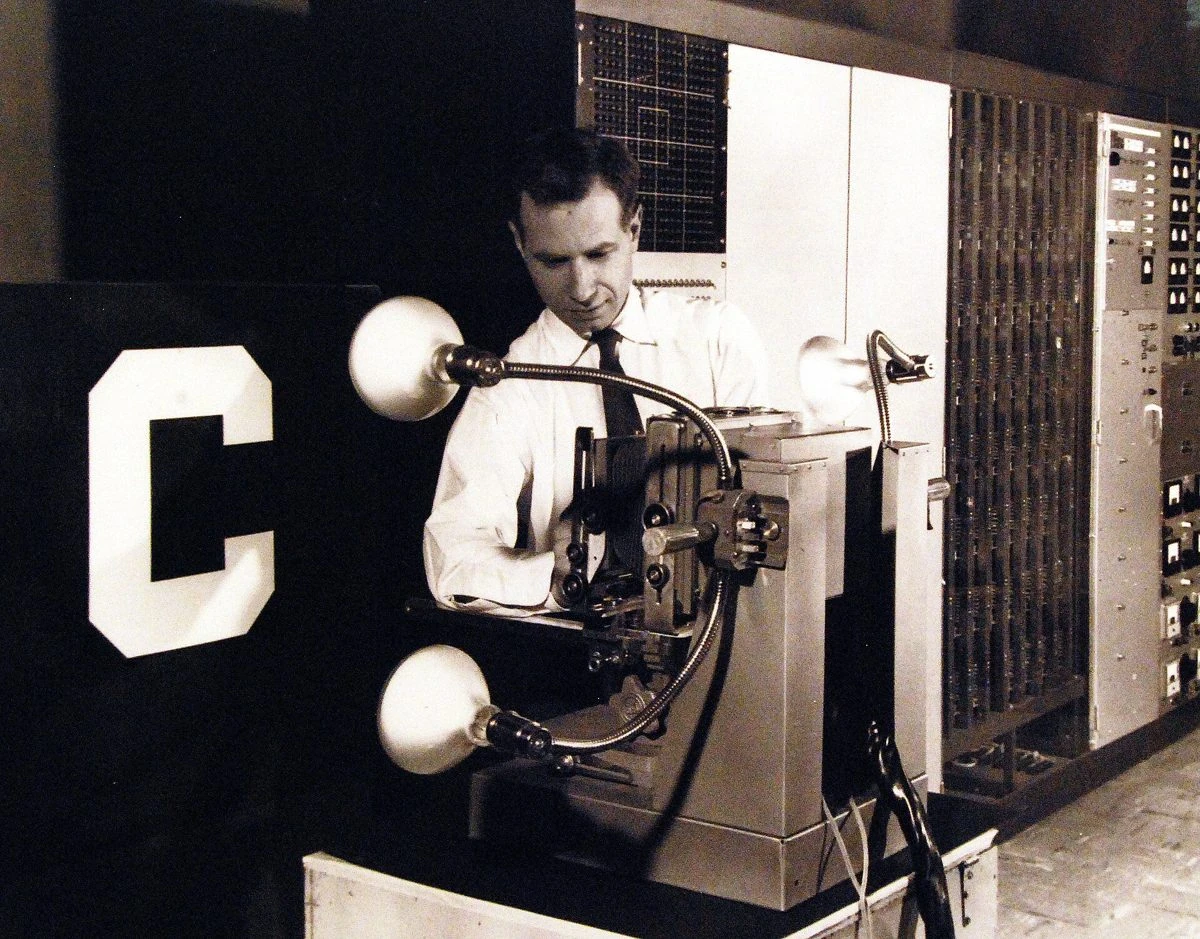
The Mark I, funded by the Navy, was the dedicated machine that realised the design in circuitry. It had 400 photocells in a 20 × 20 grid, 512 association units and weights stored in potentiometers turned by electric motors. It was shown publicly in 1960 and is now in the Smithsonian’s National Museum of American History. The photograph on this page dates from that year.
In the museum’s interpretation, the perceptron is the point where the artificial neuron moves from rules to learning. A single layer of weights, however, can only learn what can be divided by one “straight line”, and in 1969 Minsky and Papert would examine exactly that. The idea that a machine corrects its parameters from its mistakes is still at the core of how neural networks are trained today. It does not mean understanding.
Interactive learning model
Watch the weights learn from mistakes
A perceptron does not store a ready made rule for every example. When it classifies a point incorrectly, it changes its weights. The gold line is the model’s current decision boundary. Take one training step and watch the boundary move.
Learning rate: 0.35. The data are a tiny synthetic teaching set so the update rule remains visible.
New interactive exhibit · Museum Reconstruction Experience
How the Mark I Perceptron learned
See step by step how the Mark I “saw” and learned: from the 400 photocells and the random connections to the 512 association units and the potentiometers turned by motors. Start the training and watch the machine correct its mistakes, card by card.
- Documented feature of the Mark I
- Reconstructed from descriptions
- Simulation or illustrative rendering
Every part states what is documented, what is reconstructed from published descriptions and what is illustrative or simulated. The stages describe the digital reconstruction.
In 3D Room 1 you open it with the “How it works · step-by-step reconstruction” button in the showcase panel.
Text description of the reconstruction
- The machine that learned. Psychologist Frank Rosenblatt described the perceptron in 1957–1958 at the Cornell Aeronautical Laboratory. In 1958 a simulation on an IBM 704 computer learned to tell cards marked on the left from cards marked on the right. The Mark I, funded by the US Office of Naval Research, was the dedicated machine that did the same with electrical circuits; it was shown publicly in 1960 and now belongs to the Smithsonian. Certain: the inventor, the laboratory, the funding, and that the machine survives at the Smithsonian. Schematic: the cabinets here: the real machine had several racks full of cables and its layout changed between experiments.
- The “retina”: 400 photocells. The input was a 20 × 20 grid of cadmium-sulfide photocells, the S (sensory) units. A camera projected the image onto the grid and each photocell gave a signal according to the light it received. Here the image is a card with a square on the left or the right, as in the 1958 experiment. Certain: 400 photocells in a 20 × 20 grid. Simplified: here each photocell is either on or off; in reality it gave a continuous signal. The card in front of the grid is illustrative.
- Random connections. Each association unit was connected to a few photocells through a plugboard with cables. The connections were chosen at random, some excitatory and some inhibitory, and stayed fixed; they did not learn. Rosenblatt wanted to show that a system can learn without wiring designed in advance for each shape. Certain: fixed random S → A connections through a plugboard. Simulation: here each unit has 10 connections and a threshold of 1; the number of connections varied between experiments. Only a few of the cables are drawn.
- 512 association units. The 512 A (association) units were the “hidden” layer. Each adds up the signals of the photocells it is connected to and activates only if the sum exceeds its threshold. You can see which ones light up for the card being projected: each card lights up a different combination. Certain: 512 association units in the basic configuration. Simulation: which units light up follows from the random connections of this reconstruction, not from those of the original.
- Weights in motor-driven potentiometers. Each active association unit sends a signal to the response unit through a potentiometer, a variable resistor. The potentiometer’s position is the connection’s “weight”. The response unit adds up all the signals; if the total is positive it answers “right”, otherwise “left”. The machine had 8 response units; one is used here. Certain: the weights were stored in potentiometers turned by electric motors, and there were 8 response units. Illustrative: you see 64 of the potentiometers, those that change most in the simulation.
- Learning by error correction. The operator shows cards and tells the machine the correct answer. When the machine makes a mistake, the motors correct the weights of the active units. After a few dozen cards mistakes become rare and the machine also answers correctly on cards it has not seen. The limit appeared later: a single-layer perceptron learns only what can be separated by a “straight line”, as Minsky and Papert showed in 1969. Certain: the error-correction rule and the convergence theorem (Novikoff 1962) for linearly separable problems. Simulation: the 60 cards, the errors and the accuracy are computed here, live, by this model; they are not records from 1958–1960.
- Signal path: The image lights the photocells. Through the random cables each association unit adds up 10 photocells, some with a positive and some with a negative sign, and “fires” if the sum reaches its threshold. The response unit adds up the active units, each multiplied by its weight, and answers “right” if the total is positive.
- Learning from mistakes: When the answer is wrong, the motors turn the potentiometers only of the units that were active: up if the correct answer was “right”, down if it was “left”. When the answer is correct, nothing changes. This is Rosenblatt’s error-correction rule: w ← w + t·a.
Main sources:
- Rosenblatt, F. (1958). The perceptron: A probabilistic model for information storage and organization in the brain. Psychological Review 65(6), 386–408. doi.org/10.1037/h0042519
- Hay, J. C., Lynch, B. E., Smith, D. R. (1960). Mark I Perceptron Operators’ Manual. Cornell Aeronautical Laboratory, Report VG-1196-G-5. apps.dtic.mil/sti/tr/pdf/AD0236965.pdf
- Rosenblatt, F. (1962). Principles of Neurodynamics: Perceptrons and the Theory of Brain Mechanisms. Spartan Books.
- Novikoff, A. B. J. (1962). On convergence proofs on perceptrons. Symposium on the Mathematical Theory of Automata 12, 615–622.
- Minsky, M., Papert, S. (1969). Perceptrons: An Introduction to Computational Geometry. MIT Press.
- Smithsonian National Museum of American History: Mark I Perceptron.
Why it is in the museum
Here the artificial neuron moves from rules to learning. The perceptron is one of the first systems that change their own parameters from their mistakes, and its story shows how quickly a laboratory result became a promise of “thinking machines”.
What supports this exhibit
Primary scientific paper
The S–A–R architecture, the error-correction rule, the 1958 public demonstration and the Mark I.
Main source: Rosenblatt, F. (1958). The perceptron: A probabilistic model for information storage and organization in the brain. Psychological Review, 65(6), 386–408.
What needs care: A single-layer perceptron can only learn linearly separable problems. The 1958 forecasts of machines that would be “conscious” are press reports, not results.
Full documentation
- Permanent accession ID
- MTN-0010
- Exhibition position
- 1.4
- Title
- The perceptron
- Date
- 1958 · paper
- Creator / responsible institution
- Frank Rosenblatt (Cornell Aeronautical Laboratory)
- Evidence type
- Primary scientific paper
- Original / reproduction status
- The 1958 paper is not reproduced. The photograph shows the later Mark I machine (1960), not the paper.
- Provenance / custody history
- Published journal article (1958). The Mark I machine belongs to the Smithsonian National Museum of American History. The museum neither holds nor claims an original.
- Primary documentary source
- Rosenblatt, F. (1958). The perceptron: A probabilistic model for information storage and organization in the brain. Psychological Review, 65(6), 386–408.
- Image rights
- National Museum of the U.S. Navy · via Wikimedia Commons · Work of a U.S. Navy employee made in the course of official duties, public domain in the United States (verified 2026-11-21) · https://commons.wikimedia.org/wiki/File:330-PSA-80-60_(USN_710739)_(20897323365).jpg
- Certainty
- Not applicable (historical document)
- Last curatorial review
- 2026-11-21
- Next review
- 2028-11
- Visual documentation review
- 2026-11-21 · rights verified
Relationships to other exhibits
- Linked from: 1.1 The artificial neuron: the artificial neuron becomes a trainable system
- Linked from: 1.3 The Dartmouth workshop: the Dartmouth research agenda moves into experimental systems
- Linked to: 2.1 The limits of the perceptron: the perceptron’s early success meets theoretical limits
This record separates the evidence from its visual representation and records provenance, rights and curatorial relationships.
Citation & editorial transparency
Suggested citation
Independent Digital Museum of Artificial Intelligence. (2026). “The perceptron”. https://www.mouseiotn.eu/en/exhibits/perceptron/Follow the thread
Continue from here
The collection is not a set of isolated pages. See how this object connects to what came before or after.
Interactive exhibit
Talk to the exhibit
The suggested questions open curated extracts. You can also submit a question when the live service is available.
The exhibit’s “voice” is a curatorial reconstruction, not an authentic statement or actual consciousness. Documented fact, interpretation, reconstruction and uncertainty remain distinct.
Preset questions use the exhibit record in your browser. If you submit a free-text question, its text, the exhibit ID and language go to the museum API and may be forwarded to an external AI provider. Answers can contain errors. Do not enter personal information. Privacy.