Karel Čapek’s play R.U.R. popularized the word “robot”. Its artificial workers belong to fiction, not to the documented history of built humanoid machines.
The image could not load. You can open its source from the caption.
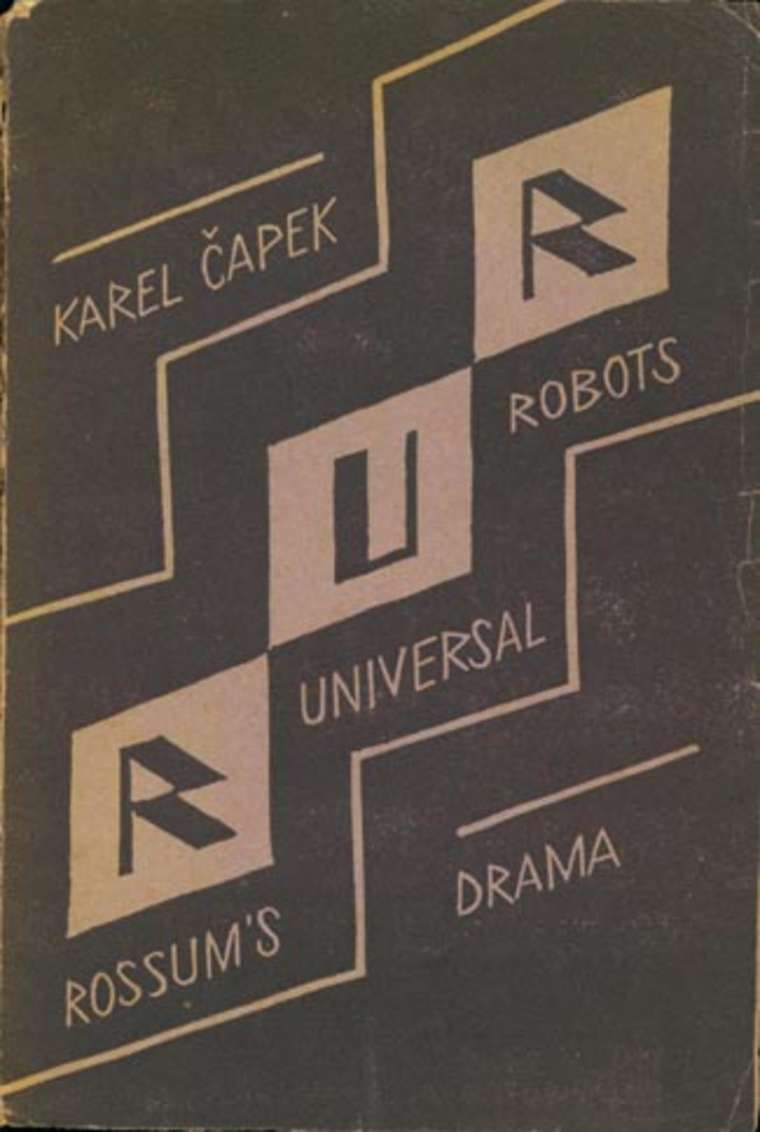
The cover of the first edition of R.U.R., Aventinum, Prague, 1920. This is a digital reproduction of a real printed document, not a new cover designed by the Museum. Commons marks this simple typographic composition as public domain, without original visual authorship. · R.U.R. · Aventinum, Prague · 1920 · Wikimedia Commons · Public domain · simple typographic cover · Image source · Object documentationSupporting curatorial card
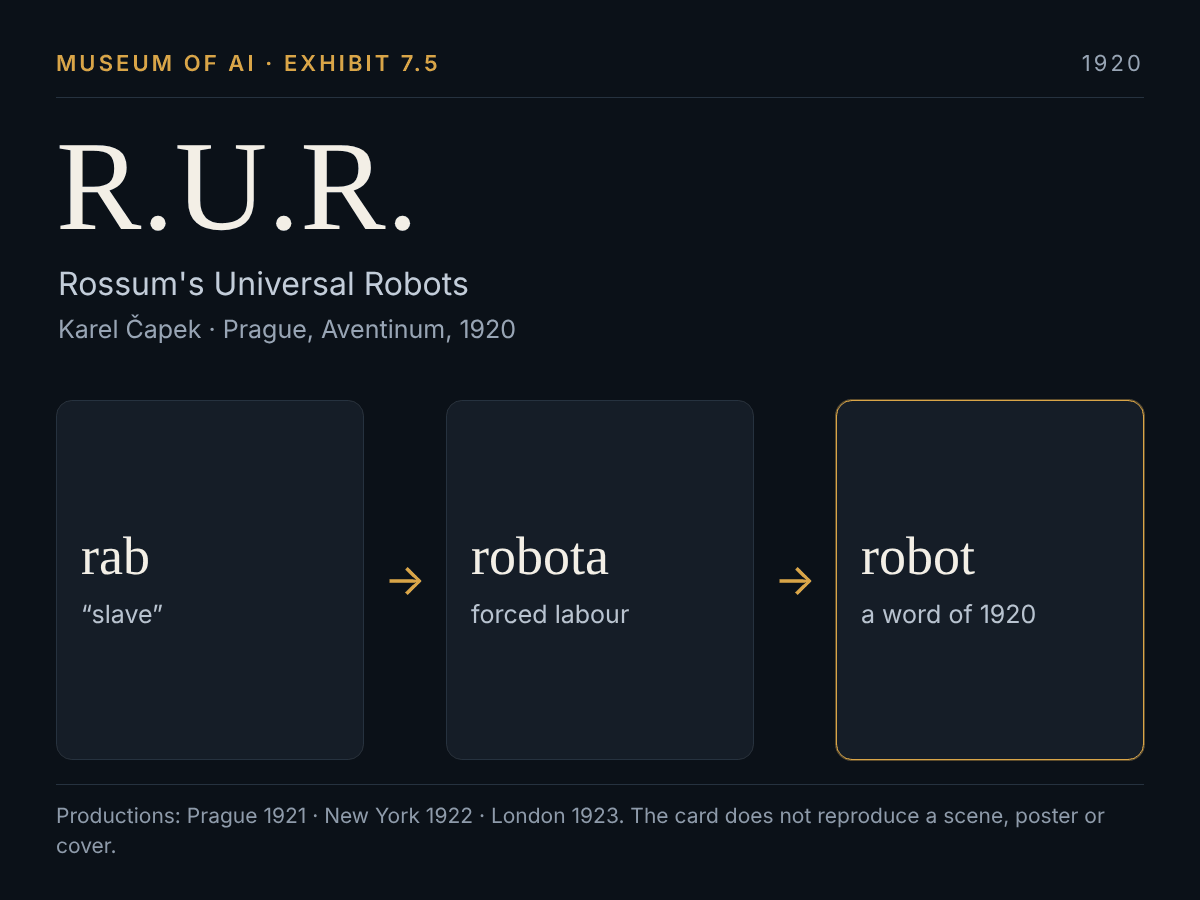
A Museum graphic supporting the explanation of this exhibit.
Curatorial document card · based on the bibliographic data of the first edition · does not reproduce a scene, poster or cover · Independent Digital Museum of Artificial Intelligence · curatorial graphic · 2026 · Original curatorial card by the Independent Digital Museum of Artificial Intelligence; no photograph, poster or cover is reproduced. Čapek’s work (d. 1938) is in the public domain in the EU.
Why it is in the museum
When AI leaves the laboratory, its consequences affect work, rights, information, privacy and accountability.
The story of the exhibit
In R.U.R., short for Rossum's Universal Robots, a company on an island manufactures artificial workers and sells them all over the world. Čapek did not imagine them as metal machines. They are artificial organisms built from synthetic organic matter, who work without tiring and without desires. In today’s vocabulary we would call them androids rather than robots.
The word was new. In Czech, robota means forced labour, like that of serfs, and it is linked to the root rab, “slave”. Čapek said the word was suggested by his brother Josef, a painter and writer, who also designed the cover of the first edition. The play was published in Prague in 1920 and reached the stage in January 1921. In 1922 and 1923 it was performed in New York and London, and from there the word “robot” entered English and science fiction.
The plot ends in revolt. The robots wipe out almost all humans. Only Alquist is spared, because he works with his hands. At the end two robots, Primus and Helena, fall in love, and Alquist sees them as a new Adam and a new Eve.
Evidence and interpretation
What is documented: the 1920 publication, the first productions and the introduction of the word “robot” into literature.
The link with today’s AI is curatorial. Čapek was writing about mass production and the labour of his own time, not about computers or algorithms. His question remains current, though: what is a being worth when its only use is its work?
Where to read the play
The Czech text is freely available from Project Gutenberg. Čapek died in 1938 and his work is in the public domain in the EU. Most later translations carry their own rights, which is why the Independent Digital Museum of Artificial Intelligence does not quote from them.
What supports this exhibit
Primary literary source
The publication of the play in 1920 and the first appearance of the word “robot” in a literary text, with artificial workers who rebel.
Main source: Čapek, K. (1920), R.U.R. (Rossum's Universal Robots), Prague: Aventinum. The Czech text is available from Project Gutenberg.
What to keep in mind: A work of literature, not a forecast. Čapek’s “robots” are biological in nature, and the link with today’s AI is curatorial interpretation.
Full documentation
What we know and how certain it is
Documented
R.U.R. was published in 1920. Its first performance took place in Hradec Králové on 2 January 1921, before the Prague staging on 25 January.
The image evokes the play, not a documented operational robot.
Provenance and rights
A citation to scientific work does not confer an image-reuse licence. Earlier image credits remain, without claiming a new rights audit.
AI conversation
The exhibit chat is a separate AI service. The live model version and expert review of each generated answer have not been verified. Sources do not guarantee correctness.
Limits of this review
Selected-claim curatorial review on 30 October 2026. No independent scientific or legal certification was undertaken.
Permanent accession ID
MTN-0067
Exhibition position
7.5
Title
R.U.R. and the word “robot”
Date
1920
Creator / responsible institution
Karel Čapek (1890–1938)
Evidence type
Primary literary source
Original / reproduction status
Digital reproduction of the first-edition cover
Provenance / custody history
Bibliographic object: Karel Čapek, R.U.R., Aventinum, Prague, 1920. The digital image comes from the Wikimedia Commons file record. The typographic designer is not identified by the source and is not arbitrarily attributed to Čapek. No copy identifier or Museum ownership is established.
Primary documentary source
Čapek, K. (1920), R.U.R. (Rossum's Universal Robots), Prague: Aventinum. The Czech text is available from Project Gutenberg.
The suggested questions open curated extracts. You can also submit a question when the live service is available.
The exhibit’s “voice” is a curatorial reconstruction, not an authentic statement or actual consciousness. Documented fact, interpretation, reconstruction and uncertainty remain distinct.
Preset questions use the exhibit record in your browser. If you submit a free-text question, its text, the exhibit ID and language go to the museum API and may be forwarded to an external AI provider. Answers can contain errors. Do not enter personal information. Privacy.