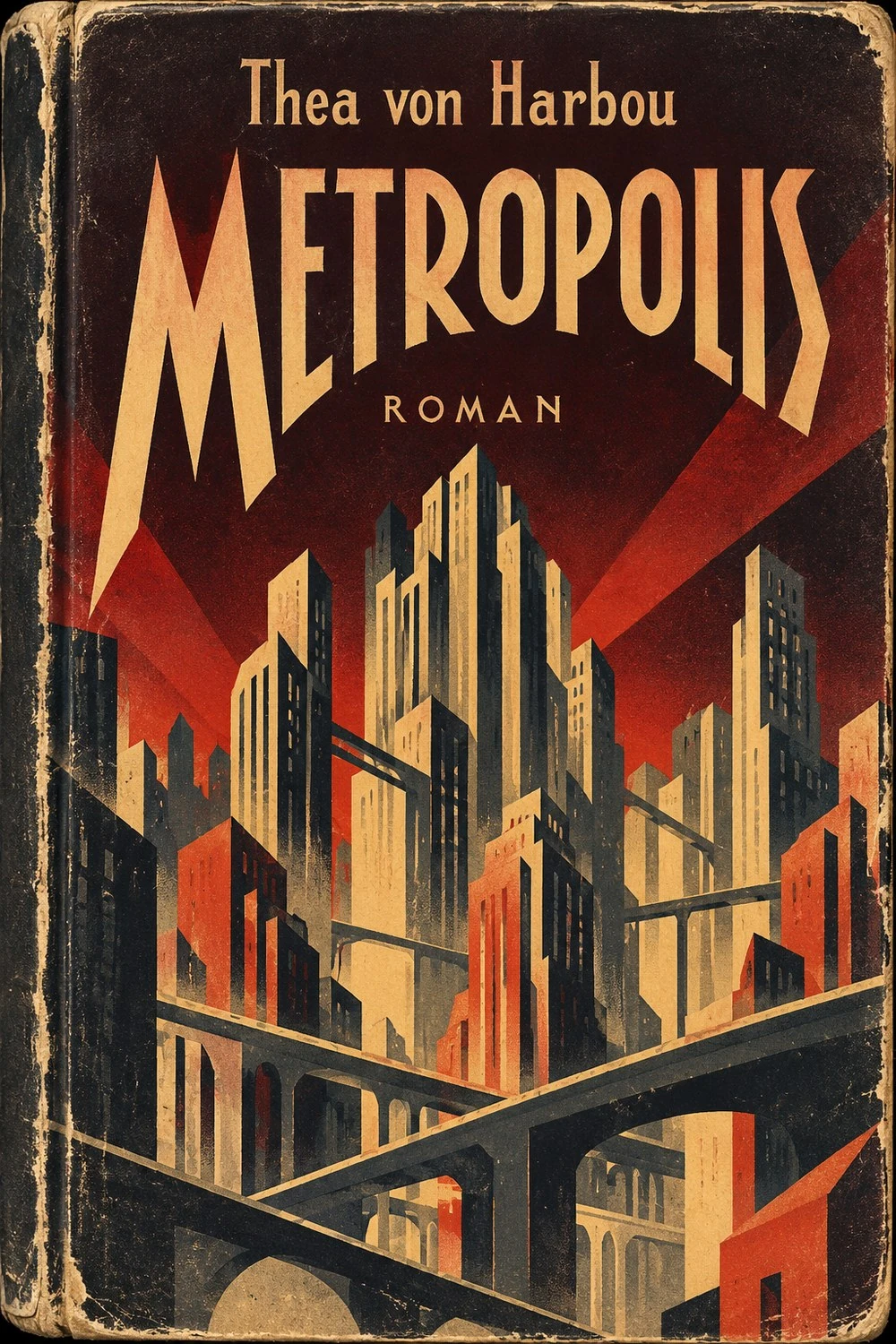
In Metropolis (1927), Rotwang gives a machine the likeness of Maria. The story explores manipulation, labour and deception through an artificial figure. It does not depict real AI; comparisons with deepfakes are contemporary interpretation.
Curatorial reconstruction based on the public-domain 1926 Metropolis cover · not a scan of the original · Independent Digital Museum of Artificial Intelligence · based on Walter Reimann’s 1926 cover · The displayed image is a Independent Digital Museum of Artificial Intelligence curatorial reconstruction. Walter Reimann’s historic cover is public domain and linked on Wikimedia Commons. The film remains a separate protected work in the EU. · Image source
Why it is in the museum
When AI leaves the laboratory, its consequences affect work, rights, information, privacy and accountability.
The story of the exhibit
The case shows a curatorial reconstruction of the German-edition cover of Thea von Harbou’s novel Metropolis, based on Walter Reimann’s public-domain original. The book predates the film version and is a separate literary document.
Metropolis premiered in Berlin on 10 January 1927 at the UFA-Palast am Zoo. Fritz Lang directed. Thea von Harbou wrote the screenplay alongside her novel of the same name, and Gottfried Huppertz composed the score. The city of the title is split into two worlds: above live those who own and decide, below the workers tend the machines.
At the centre of the plot is a robot, the “Maschinenmensch”. The inventor Rotwang gives it the face of Maria, a young woman who urges the workers to be patient and reconcile. In that form the robot pushes them into revolt. The workers wreck the machines and the danger falls on their own children. In the end they burn the robot, and the fire reveals that it was never human.
The film we see today is the product of restoration. After the premiere it was shortened: Paramount’s American version was cut to about 3,100 metres and Ufa’s German one to about 3,241, from the 4,189 metres of the premiere. In 1998 the Friedrich-Wilhelm-Murnau-Stiftung commissioned a restoration by Martin Koerber. The result, 124 minutes long, was presented in Berlin in 2001. In 2008 a 16 mm negative of Lang’s version was found in Buenos Aires, and the 2010 restoration runs 148 minutes, against about 153 at the premiere. In 2001 the film was inscribed on UNESCO’s Memory of the World register.
Evidence and interpretation
What is documented: the plot, the production data and the path of the versions up to the 2001 restoration, sourced from the restorer’s own study.
Reading the robot Maria as a forerunner of deepfakes is curatorial. The film is about class tension and the control of crowds, not about verifying identity. It remains, however, one of the earliest images of a machine that earns trust because it looks like someone familiar.
Rights and access
The case image is a curatorial reconstruction of the 1926 German Metropolis cover, based on Walter Reimann’s public-domain original. It is not a scan of the historic object. Wikimedia Commons provides the original cover and marks it public domain. This concerns the book, not film material.
In the United States the film entered the public domain on 1 January 2023. In Germany and the rest of the EU it is protected until the end of 2046, 70 years after Lang’s death in 1976, and modern restorations carry their own rights. For that reason the Independent Digital Museum of Artificial Intelligence does not host frames, photographs or posters from the film and does not link to unofficial uploads. You can watch it from lawful sources, such as editions from the rights holders or a film archive.
For the history of the versions, see Martin Koerber’s study listed as the main source.
What supports this exhibit
Primary film evidence and restoration study
The production data of the film, its shortening after the premiere and the 2001 restoration.
Main source: Lang, F. (1927), Metropolis, Ufa, Berlin. On the versions and the restoration: Koerber, M., “Notes on the Proliferation of Metropolis (1927)”, Danish Film Institute, Preserve Then Show.
What to keep in mind: The film is a work of fiction. The history of the versions is documented by the restorer’s study; the details for 2008 and 2010 come from secondary literature.
Full documentation
Permanent accession ID
MTN-0068
Exhibition position
7.6
Title
Metropolis and the machine with Maria’s face
Date
1927 · film
Creator / responsible institution
Fritz Lang (director) · Thea von Harbou (screenplay) · Ufa
Evidence type
Primary film evidence and restoration study
Original / reproduction status
Curatorial reconstruction of a public-domain book cover
Provenance / custody history
A work in public circulation. The Independent Digital Museum of Artificial Intelligence documents the source and does not claim ownership of the original.
Primary documentary source
Lang, F. (1927), Metropolis, Ufa, Berlin. On the versions and the restoration: Koerber, M., “Notes on the Proliferation of Metropolis (1927)”, Danish Film Institute, Preserve Then Show.
Image rights
Independent Digital Museum of Artificial Intelligence · based on Walter Reimann’s 1926 cover · The displayed image is a Independent Digital Museum of Artificial Intelligence curatorial reconstruction. Walter Reimann’s historic cover is public domain and linked on Wikimedia Commons. The film remains a separate protected work in the EU. · https://commons.wikimedia.org/wiki/File:Harbou_Metropolis_1926_cover.jpg
Certainty
Documented
Last curatorial review
2026-10-11
Next review
2027-04-16
Visual documentation review
2026-10-12 · v7.85.4
Relationships to other exhibits
Linked to: 7.1 Deepfakes: the machine that takes a familiar face and today’s deepfakes
Walter Reimann’s 1926 book-cover artwork has a different rights history from the film and its restored print. The museum artwork is not an authentic film frame.
The Walter Reimann book cover (1926) is recorded as public domain by Wikimedia Commons. That status does not apply to the film or its 2010 restoration: filmportal lists the Murnau Foundation as the rights holder. The museum image is labelled an editorial reconstruction; its full creation history has not been verified.
3D and educational rendering
Any 3D depiction of this subject in the museum is an editorial or teaching illustration. An exact match to an archaeological object, cinematic original or independently validated mechanical model is not established.
AI conversation
Free-text answers from “Talk to the exhibit” are AI-generated. This package does not establish which exact model and version responds to each visitor, or independent validation of every response. A limited source set cannot guarantee accuracy.
Scope of review
A source-based curatorial review, not external scientific certification. No independent subject-expert assessment is documented for this exhibit.
Citation & editorial transparency
Suggested citation
Independent Digital Museum of Artificial Intelligence. (2026). “Metropolis and the machine with Maria’s face”. https://www.mouseiotn.eu/en/exhibits/metropolis-the-machine-with-marias-face/
Original curatorial text licence:CC BY-SA 4.0. This licence does not cover third-party material listed separately.
If you spot an error, keep the collection number and main source. The correction and reclassification process is described in the Collections Policy.
The novel and the film
Metropolis exists in two distinct forms. Thea von Harbou wrote the novel and the screenplay while working alongside Fritz Lang from 1924, and shooting began in May 1925. The novel was serialised in Das Illustrierte Blatt and published as a book by August Scherl in Berlin in 1926, shortly before the film's premiere in January 1927. Sources disagree on whether the serial began in 1925 or 1926. The film is therefore not simply the adaptation of an already finished book, and the book is not simply a novelisation of the film. The literary work of von Harbou, who died in 1954, is in the public domain in the EU. The film remains protected until the end of 2046.
Follow the thread
Continue from here
The collection is not a set of isolated pages. See how this object connects to what came before or after.
The suggested questions open curated extracts. You can also submit a question when the live service is available.
The exhibit’s “voice” is a curatorial reconstruction, not an authentic statement or actual consciousness. Documented fact, interpretation, reconstruction and uncertainty remain distinct.
Preset questions use the exhibit record in your browser. If you submit a free-text question, its text, the exhibit ID and language go to the museum API and may be forwarded to an external AI provider. Answers can contain errors. Do not enter personal information. Privacy.