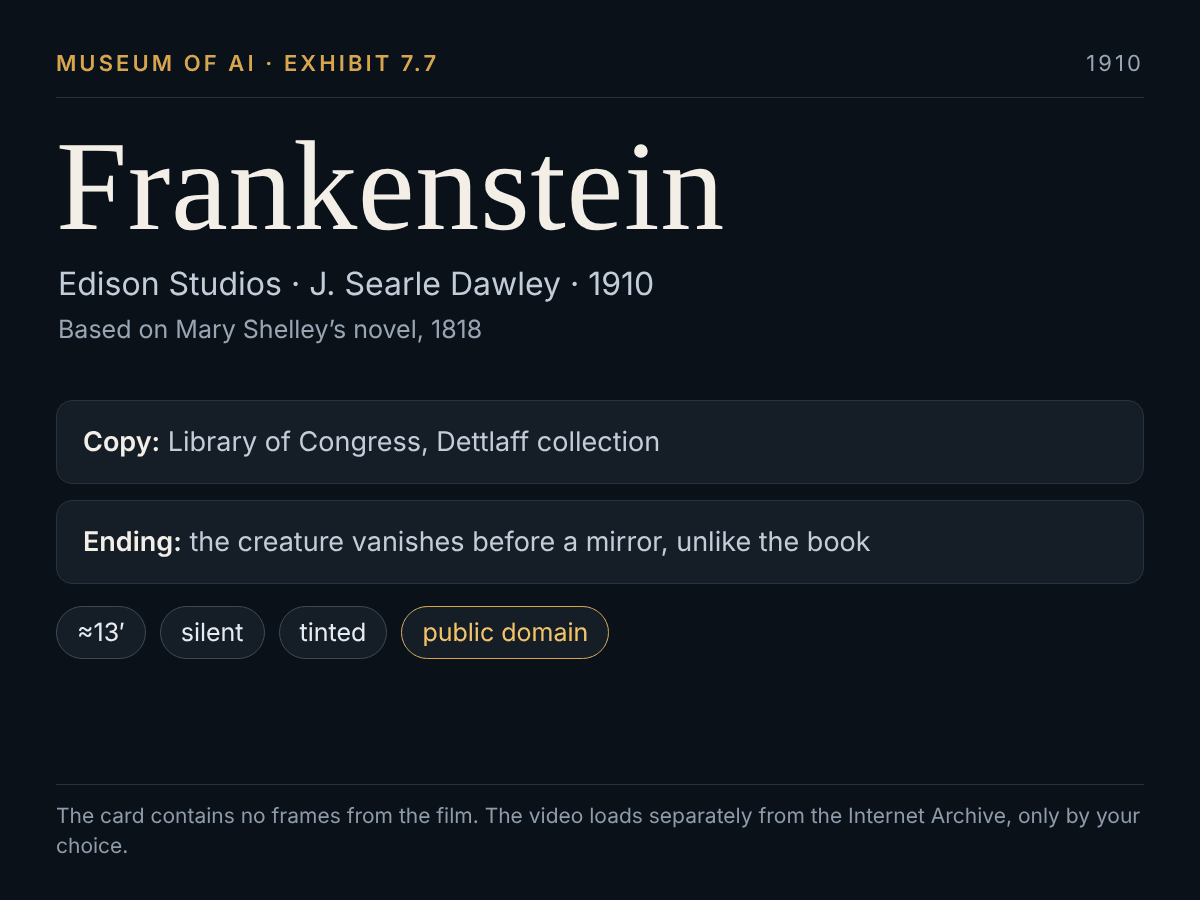
This exhibit concerns Frankenstein (1910), a silent film directed by J. Searle Dawley for the Edison Manufacturing Company and adapted from Mary Shelley’s 1818 novel. The film reinterprets the creator’s responsibility towards the creature. It is not evidence of historical AI.
Curatorial document card · based on Library of Congress data · contains no frames from the film, which are offered separately in the video below · Independent Digital Museum of Artificial Intelligence · curatorial graphic · 2026 · The museum produced this curatorial card. Rights for the film, this particular digital copy and any accompanying music are assessed separately.
Why it is in the museum
When AI leaves the laboratory, its consequences affect work, rights, information, privacy and accountability.
The story of the exhibit
Mary Shelley published Frankenstein; or, The Modern Prometheus anonymously in London in 1818. A student of science creates a living being and, as soon as he sees it, abandons it. The book is not mainly asking whether such a thing can be done. It asks what a creator owes to the creature.
The 1910 film is one of the first known screen versions of the story. J. Searle Dawley wrote and directed it at the Edison studios in New York. It runs about 13 minutes, is silent, and its shots carry colour tinting. Its ending departs from the book: the creature vanishes before the mirror as Frankenstein’s love for his wife grows.
The copy you can watch below comes from the Dettlaff collection of the Library of Congress. One of its sources is a paper-print fragment held at the Thomas Edison National Historical Park.
Watch the film
The original 1910 film is silent and about 13 minutes long (12:41 in the Internet Archive copy). The digital copy may include accompanying audio or music. The video loads from the Internet Archive only when you press the button, so that no data is sent to a third party before you decide.
Description of the film for those who cannot view the video
A student, Frankenstein, decides to create the perfect human being and brings the creature to life in a vat of chemicals. On his wedding day he sees the creature’s reflection in a mirror, and later the creature returns seeking acceptance. When Frankenstein stands before the same mirror, the creature’s image fades, signifying its destruction as his love for his wife grows. (Description based on the Library of Congress record.)
Source and licence: Edison Manufacturing Co., 1910 · Library of Congress, Dettlaff collection · Internet Archive (CC BY 3.0 for the digital edition). The original 1910 film is silent; the digital copy may include accompanying audio or music.
Evidence and interpretation
What is documented: the 1818 publication of the novel, the 1910 film with its makers, and the provenance of the copy.
The link with today’s AI is curatorial. The story is not about algorithms but about a creator’s responsibility, which is why it returns in current discussions of alignment and the control of advanced systems.
What supports this exhibit
Primary film evidence
The existence and content of the 1910 film, its makers and the provenance of the copy.
Main source: Dawley, J. S. (1910), Frankenstein, Edison Manufacturing Co., New York. Digital copy: Library of Congress, Dettlaff collection. Background: Shelley, M. (1818), Frankenstein; or, The Modern Prometheus, London.
The image represents literary or cinematic fiction, not a real scientific construction.
Provenance and rights
A citation to scientific work does not confer an image-reuse licence. Earlier image credits remain, without claiming a new rights audit.
AI conversation
The exhibit chat is a separate AI service. The live model version and expert review of each generated answer have not been verified. Sources do not guarantee correctness.
Limits of this review
Selected-claim curatorial review on 30 October 2026. No independent scientific or legal certification was undertaken.
Permanent accession ID
MTN-0069
Exhibition position
7.7
Title
Frankenstein: the creator and the creature
Date
1910
Creator / responsible institution
J. Searle Dawley (writer and director) · Edison Manufacturing Co.
Evidence type
Primary film evidence
Original / reproduction status
Curatorial document card
Provenance / custody history
A work in public circulation. The Independent Digital Museum of Artificial Intelligence documents the source and does not claim ownership of the original.
Primary documentary source
Dawley, J. S. (1910), Frankenstein, Edison Manufacturing Co., New York. Digital copy: Library of Congress, Dettlaff collection. Background: Shelley, M. (1818), Frankenstein; or, The Modern Prometheus, London.
Image rights
Independent Digital Museum of Artificial Intelligence · curatorial graphic · 2026 · The museum produced this curatorial card. Rights for the film, this particular digital copy and any accompanying music are assessed separately.
Certainty
Evidence assessed per claim
Last curatorial review
2026-10-30
Next review
2027-04-16
Visual documentation review
2026-10-12 · v7.85.4
Relationships to other exhibits
Linked to: 6.5 Alignment: the creator’s responsibility and the alignment of AI systems
This record separates the evidence from its visual representation and records provenance, rights and curatorial relationships.
Citation & editorial transparency
Suggested citation
Independent Digital Museum of Artificial Intelligence. (2026). “Frankenstein: the creator and the creature”. https://www.mouseiotn.eu/en/exhibits/frankenstein-the-creator-and-the-creature/
The suggested questions open curated extracts. You can also submit a question when the live service is available.
The exhibit’s “voice” is a curatorial reconstruction, not an authentic statement or actual consciousness. Documented fact, interpretation, reconstruction and uncertainty remain distinct.
Preset questions use the exhibit record in your browser. If you submit a free-text question, its text, the exhibit ID and language go to the museum API and may be forwarded to an external AI provider. Answers can contain errors. Do not enter personal information. Privacy.