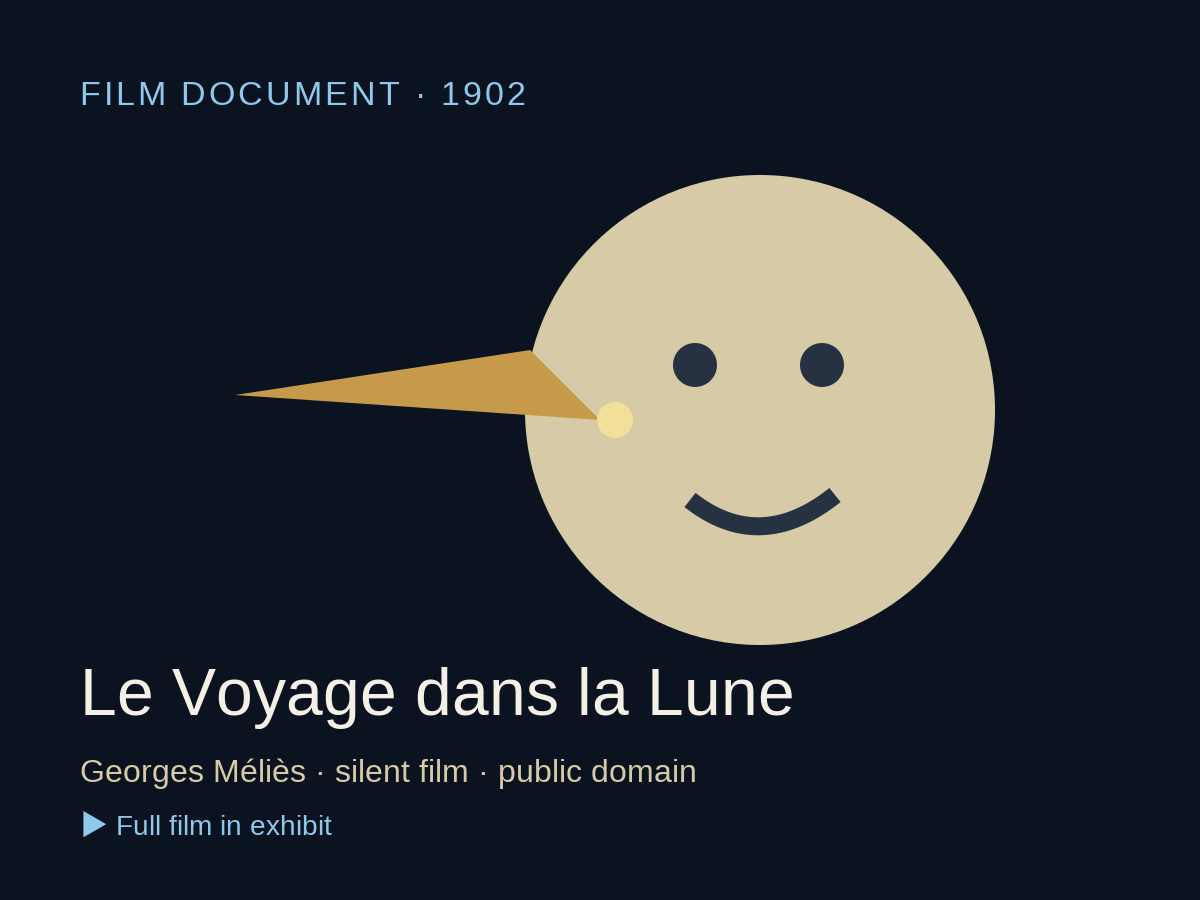
Georges Méliès’s A Trip to the Moon (1902) imagines a lunar voyage through theatrical sets and cinematic effects. It depicts neither artificial intelligence nor a real autonomous machine.
The full silent film is provided in the exhibit and 3D label as a public-domain digital copy. · Independent Digital Museum of Artificial Intelligence · curatorial card · 2026 · The card is original Independent Digital Museum of Artificial Intelligence material. Wikimedia Commons marks the film file as public domain. · Image source
Why it is in the museum
Because it shows how technological imagination can precede real technologies. The exhibit does not present the film as a work about AI or as a prediction of it; it places the film within the cultural history through which people imagine machines and technical achievements before they become possible.
The story of the exhibit
In 1902 Georges Méliès directed Le Voyage dans la Lune. A group of astronomers travels to the Moon in a capsule fired from a cannon. The film became iconic for its sets, visual tricks and the image of the capsule landing in the Moon’s face.
Its place in the Independent Digital Museum of Artificial Intelligence does not depend on an anachronism. There is no “AI” in the film. What it documents is an older cultural habit: using fiction to imagine what machines might do before the corresponding technologies exist.
Watch the film
This digital copy comes from Wikimedia Commons, which marks it as public domain. The film is silent and the Independent Digital Museum of Artificial Intelligence does not add a modern soundtrack.
Its place in this museum concerns technological imagination, not an early AI invention. Rights in any modern restoration must be considered separately.
This is a film scene or curatorial rendering, not a historical spacecraft.
Provenance and rights
A citation to scientific work does not confer an image-reuse licence. Earlier image credits remain, without claiming a new rights audit.
AI conversation
The exhibit chat is a separate AI service. The live model version and expert review of each generated answer have not been verified. Sources do not guarantee correctness.
Limits of this review
Selected-claim curatorial review on 30 October 2026. No independent scientific or legal certification was undertaken.
Permanent accession ID
MTN-0070
Exhibition position
7.8
Title
A Trip to the Moon: machines before AI
Date
1902
Creator / responsible institution
Georges Méliès
Evidence type
Primary film document
Original / reproduction status
Curatorial card + externally hosted digital copy of the full film
Provenance / custody history
This record concerns Georges Méliès’s 1902 film. The Museum does not hold a physical copy; it points to a digital copy hosted by the Internet Archive and documented through Wikimedia Commons.
Primary documentary source
Wikimedia Commons, Le Voyage dans la Lune (1902), sourced from Internet Archive
Image rights
Wikimedia Commons marks the work and file as public domain / Public Domain Mark. Méliès died in 1938. No later restoration or soundtrack with separate rights is used.
The record separates the historical document from its curatorial placement in AI history and documents provenance and rights.
Citation & curatorial transparency
Suggested citation
Independent Digital Museum of Artificial Intelligence. (2026). “A Trip to the Moon: machines before AI”. https://www.mouseiotn.eu/en/exhibits/a-trip-to-the-moon-1902/
The suggested questions open curated extracts. You can also submit a question when the live service is available.
The exhibit’s “voice” is a curatorial reconstruction, not an authentic statement or actual consciousness. Documented fact, interpretation, reconstruction and uncertainty remain distinct.
Preset questions use the exhibit record in your browser. If you submit a free-text question, its text, the exhibit ID and language go to the museum API and may be forwarded to an external AI provider. Answers can contain errors. Do not enter personal information. Privacy.