Wolfgang von Kempelen’s Mechanical Turk appeared to play chess autonomously, but a concealed human player determined the moves.
The image could not load. You can open its source from the caption.
A historical image from Joseph Friedrich von Racknitz’s 1789 publication on Kempelen’s chess automaton. It is genuine evidence of the period and of attempts to explain the illusion. It is not a photograph of the original 1770 automaton or a verified construction drawing of its interior. · Joseph Friedrich von Racknitz (publication, 1789) · Humboldt University Library / Wikimedia Commons · Public domain · 1789 printed illustration · Image source · Object documentationSupporting curatorial card
A Museum graphic supporting the explanation of this exhibit.
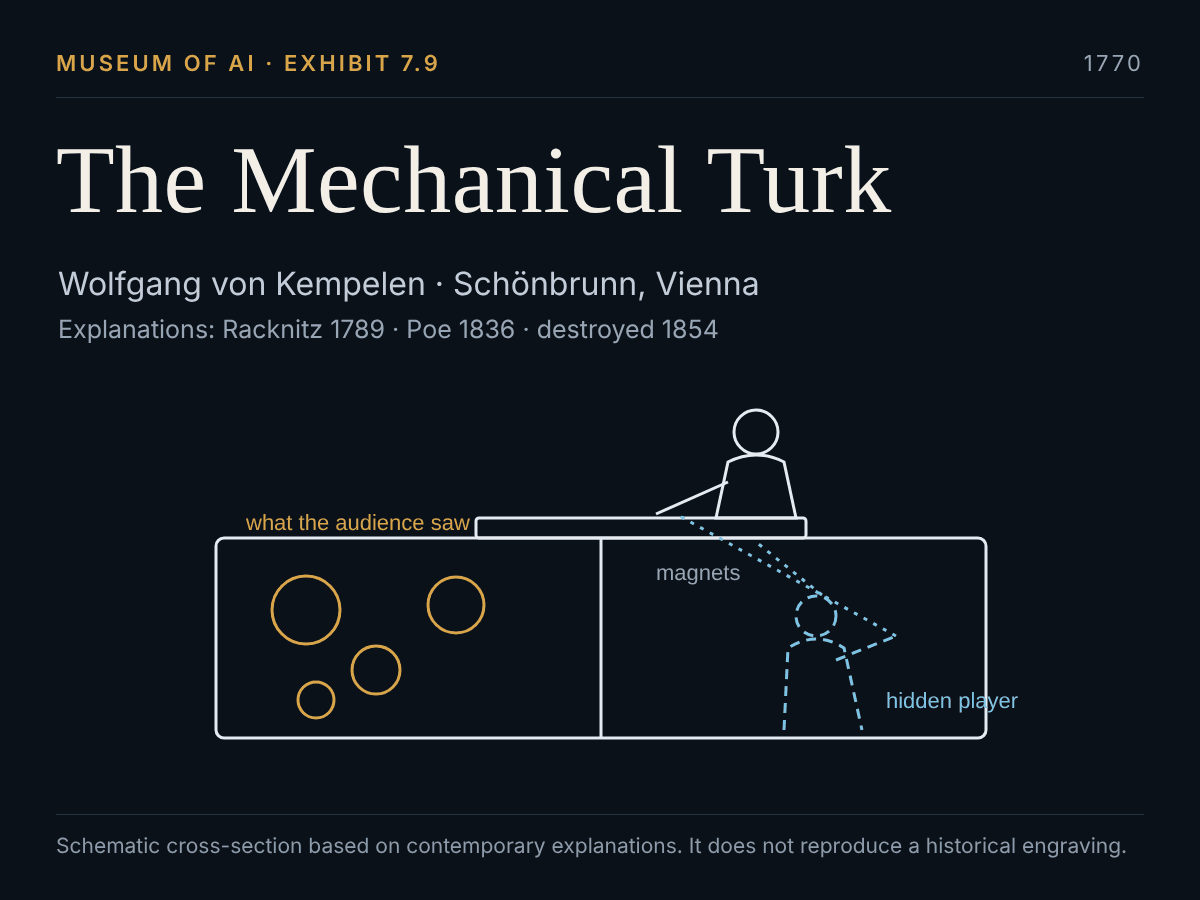
Curatorial document card · schematic cross-section of the explanation given by the automaton’s contemporaries · does not reproduce a historical engraving · Independent Digital Museum of Artificial Intelligence · curatorial graphic · 2026 · Original Independent Digital Museum of Artificial Intelligence card and interactive reconstruction. No historical engraving is reproduced. Poe’s essay (1836) is in the public domain.
Why it is in the museum
When AI leaves the laboratory, its consequences affect work, rights, information, privacy and accountability.
Object in three dimensions
Open the cabinet as the exhibitor did
Before every game the cabinet was opened in front of the audience, door by door, in a fixed order. Follow the stages of the demonstration, then switch on the “X-ray” to see what the spectators could not: where the chess player was at every moment.
Digital reconstruction from contemporary descriptions · the original was destroyed in 1854
width ≈ 107 cm (3.5 ft)
cabinet height ≈ 76 cm
Drag to rotate · scroll or pinch to zoom
The points of the cabinet as text
The chessboard and the magnetsthin top · magnets in the pieces
The chessboard was thin enough for a magnet to act through it. According to later explanations, each piece had a magnet in its base that held a small metal marker under the top. When the opponent lifted a piece, the hidden player saw the marker drop and knew which move had been made.
Certain: the thin board and the magnets. Schematic: the number and position of the markers in the model.
The clockwork cupboardleft cupboard · only a third deep
The gears, cylinders and levers filled only the front third of the left cupboard. With the rear door open as well, the audience believed they could see right through the machine. Behind a false partition there was room for a person.
Certain: the show machinery and its limited depth. Schematic: the shape and arrangement of the gears.
The drawerchessmen · box of counters · cushion
From the drawer came the chessmen, a small box of counters and a cushion on which the figure rested its arm between moves. Like the clockwork, the drawer did not reach the back. The space behind it was free for the player’s legs.
Certain: the contents of the drawer and its shallow depth. Schematic: its dimensions.
The large cupboardtwo doors · dark cloth · few mechanical parts
The large cupboard held only a few pieces of machinery and was lined with dark cloth, like the left one. The darkness made the space look empty and hard to judge in depth.
Certain: the cloth lining and the few mechanical parts. Schematic: their position.
The hidden playersliding seat · follows the doors
The chess player sat on a seat that slid inside the cabinet. As the doors opened and closed he changed position, so that he was always where the audience was not looking. Press “X-ray” and run the stages again. We do not know for certain who the first hidden players were.
Certain: the hidden person and the sliding seat. Interpretation: his exact route, which does not survive. The blue figure is schematic.
The rear door and the candleback of the cabinet · lighting the demonstration
The exhibitor also opened the door at the back of the left cupboard and held a lit candle at the opening. The light passing between the gears convinced spectators that nothing was hidden behind them.
Certain: the rear door and the candle in the demonstration. Schematic: the size of the door.
The figurecarved wood · fur-trimmed kaftan · pipe
The figure was carved in wood at life size and wore a fur-trimmed kaftan, clothing that Europeans of the time associated with the East. At rest it held a long pipe. Under its garments were two small doors, which were also opened during the demonstration. According to the descriptions it nodded twice when threatening the opponent’s queen and three times when giving check.
Certain: the pipe, the fur-trimmed garment, the doors under the garments, the nods. Curatorial choice: the face is rendered with calm, neutral features rather than the exaggerated traits often given in depictions of the period. The colours are indicative.
About this model
Type
3D digital reconstruction from contemporary descriptions. The automaton burned in Philadelphia in 1854 and no part of it survives.
Dimensions
Cabinet 3.5 × 2 × 2.5 feet (about 107 × 61 × 76 cm), as described by a 19th-century witness. 18-inch chessboard.
Interior
Interpretation based on accounts of the demonstration and analyses by contemporaries. The exact layout and the player’s route do not survive.
The figure
A carved wooden figure with calm, neutral features. It follows what is described (fur-trimmed kaftan, turban, pipe) and is not a portrait of the original figure. The colours are indicative.
Made by
Independent Digital Museum of Artificial Intelligence (Mouseio TN), 2026. Built in code, without third-party photographs or drawings.
The Mechanical Turk was a large wooden cabinet with a chessboard on top and, behind it, a human figure in clothing that Europeans of the time associated with the East, which gave it its name. Von Kempelen, an official at the Habsburg court, presented it at Schönbrunn Palace in 1770. Before each game the exhibitor opened the cupboards one by one and showed gears and mechanisms. The audience saw a machine.
The chess player hidden inside moved as the doors opened and closed. He followed his opponent’s moves through the board, thanks to magnets under the pieces, and moved the figure’s arm through a linkage. After Kempelen’s death in 1804 the automaton passed to Johann Nepomuk Mälzel, who toured it in Europe and, from 1826, in the United States. Stories of games against Napoleon and Benjamin Franklin are widely told, but many of their details are contradictory. The Turk was destroyed by fire in Philadelphia on 5 July 1854.
Many tried to explain the trick. Joseph Friedrich von Racknitz published drawings in 1789 of how he believed the player was concealed. In 1836 Edgar Allan Poe wrote in the Southern Literary Messenger that the automaton’s operations were regulated “by mind, and by nothing else”. One of his arguments was that a pure machine would always win, whereas the Turk sometimes lost. Many of his guesses about the mechanism were wrong. His main conclusion was right.
Open the cabinet
A simplified cross-section based on the explanations of its contemporaries. It does not reproduce the exact interior layout, which does not survive.
The cabinet is closed. The audience sees only the chessboard and the figure.
From Poe’s text (1836)
“It is quite certain that the operations of the Automaton are regulated by mind, and by nothing else.”
“Were the machine a pure machine this would not be the case: it would always win.”
The automaton’s existence from 1770, its tours, the explanations by Racknitz (1789) and Poe (1836) and its destruction in 1854 are documented. The exact year of completion, the identity of the first hidden players and the details of games against famous people remain uncertain.
The Turk is not an ancestor of AI as a technology. It is an ancestor of a recurring question: how much human labour is hidden behind a machine that looks intelligent? In 2005 Amazon gave its name to a platform where people carry out small tasks that computers could not do. The images of ImageNet, for example, were labelled there. Poe’s argument also holds an irony: today we know that a real machine can lose too.
What supports this exhibit
Contemporary historical testimony
The public debate about the automaton in the United States and the argument that a hidden human operated it.
Main source: Poe, E. A. (1836), “Maelzel’s Chess-Player”, Southern Literary Messenger, vol. 2, April 1836, pp. 318–326. Text on the website of the Edgar Allan Poe Society of Baltimore.
What to keep in mind: The automaton does not survive. Poe was right in his conclusion, not in every detail. Games against famous people rest on later and contradictory accounts.
How this exhibit was made
What the image is
Reproduction of a historical engraving from Racknitz’s 1789 publication. It is not a photograph of the automaton, which does not survive.
Origin and licence
Public domain. Digitisation: Humboldt University Library, via Wikimedia Commons.
What the museum changed
None. Shown at a reduced size. The cross-section in the interactive is an original museum drawing.
Was AI used for the image?
No.
Text
Original curatorial text by the Museum of AI, licensed CC BY-SA 4.0. The main source is listed in the exhibit record.
Interactives and voice
The cabinet cross-section is an educational reconstruction based on contemporary explanations, not a construction drawing. The “voice” in “Talk to the exhibit” is a curatorial representation. When live AI is available, the exhibit record supplies context. Generated answers can contain errors. The audio guide reads the curated text.
Pilot transparency section. It describes only what is recorded in the exhibit’s register.
Full documentation
What we know and how certain it is
Strongly supported
The chess-playing automaton was built around 1770 and publicly demonstrated as a chess machine.
The image cannot establish autonomous machine thought: the human operator was hidden.
Provenance and rights
A citation to scientific work does not confer an image-reuse licence. Earlier image credits remain, without claiming a new rights audit.
AI conversation
The exhibit chat is a separate AI service. The live model version and expert review of each generated answer have not been verified. Sources do not guarantee correctness.
Limits of this review
Selected-claim curatorial review on 30 October 2026. No independent scientific or legal certification was undertaken.
Permanent accession ID
MTN-0071
Exhibition position
7.9
Title
The Mechanical Turk: the machine that hid a human
Date
1770
Creator / responsible institution
Wolfgang von Kempelen (1734–1804)
Evidence type
Contemporary historical testimony
Original / reproduction status
Reproduction of a historical 1789 engraving
Provenance / custody history
Printed image from Racknitz’s 1789 publication, digitisation attributed by Commons to Humboldt University Library. The old two-dimensional image and its faithful reproduction are marked public domain. Racknitz is recorded as responsible for the publication without inventing an engraver’s identity.
Primary documentary source
Poe, E. A. (1836), “Maelzel’s Chess-Player”, Southern Literary Messenger, vol. 2, April 1836, pp. 318–326. Text on the website of the Edgar Allan Poe Society of Baltimore.
Image rights
Joseph Friedrich von Racknitz (publication, 1789) · Humboldt University Library / Wikimedia Commons · Public domain · 1789 printed illustration · https://commons.wikimedia.org/wiki/File:Racknitz_-_The_Turk_1.jpg
Certainty
Evidence assessed per claim
Last curatorial review
2026-10-30
Next review
2027-04-16
Visual documentation review
2026-10-12 · v7.85.5
Relationships to other exhibits
Linked to: 3.2 ImageNet: ImageNet’s images were labelled by people on the platform named after the Turk
Linked to: 2.5 Deep Blue defeats Kasparov: from a machine that pretended to play chess to one that beat the world champion
This record separates the evidence from its visual representation and records provenance, rights and curatorial relationships.
Citation & editorial transparency
Suggested citation
Independent Digital Museum of Artificial Intelligence. (2026). “The Mechanical Turk: the machine that hid a human”. https://www.mouseiotn.eu/en/exhibits/the-mechanical-turk/
The suggested questions open curated extracts. You can also submit a question when the live service is available.
The exhibit’s “voice” is a curatorial reconstruction, not an authentic statement or actual consciousness. Documented fact, interpretation, reconstruction and uncertainty remain distinct.
Preset questions use the exhibit record in your browser. If you submit a free-text question, its text, the exhibit ID and language go to the museum API and may be forwarded to an external AI provider. Answers can contain errors. Do not enter personal information. Privacy.