Displayed in 1939, the Voder generated synthetic speech with electrical circuits, keys and levers operated by a trained person. It did not understand or independently compose sentences.
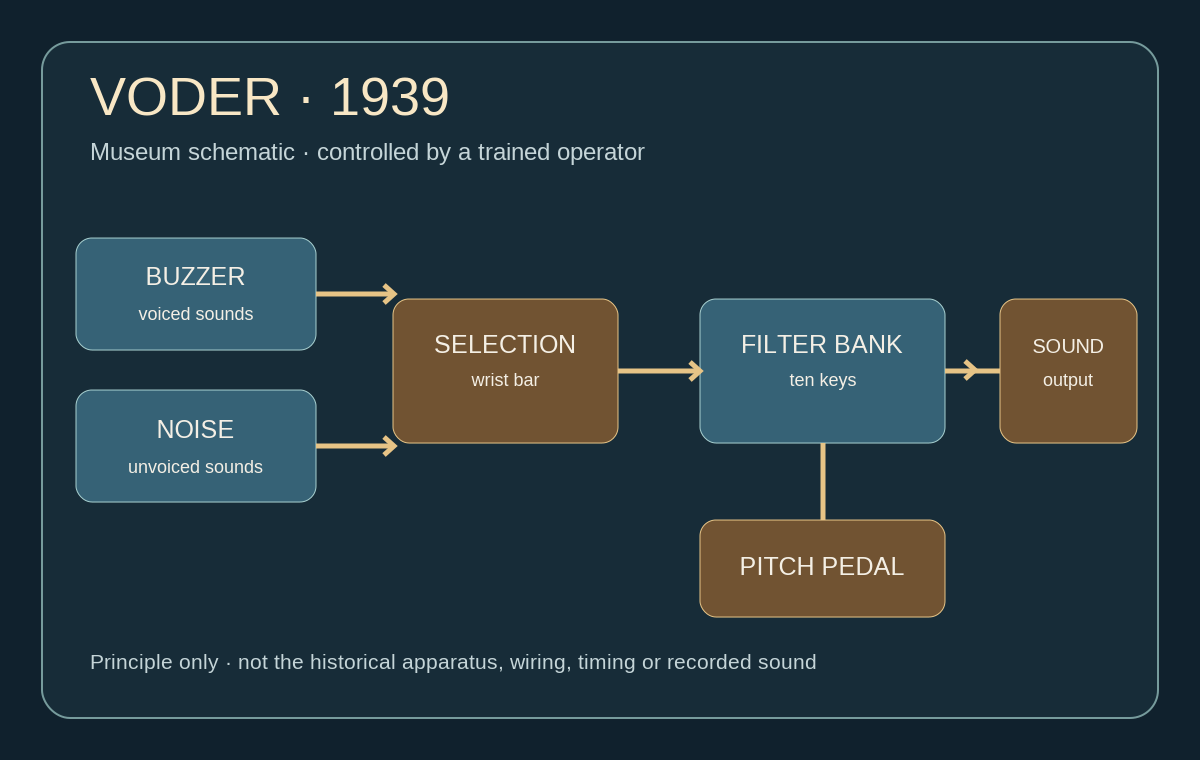
Original museum diagram of the Voder operating principle. It is neither a historical photograph nor an exact circuit reconstruction. The 1939 demonstration photograph remains an external source; its ambiguous rights statement is not treated as a reuse license.Supporting curatorial card
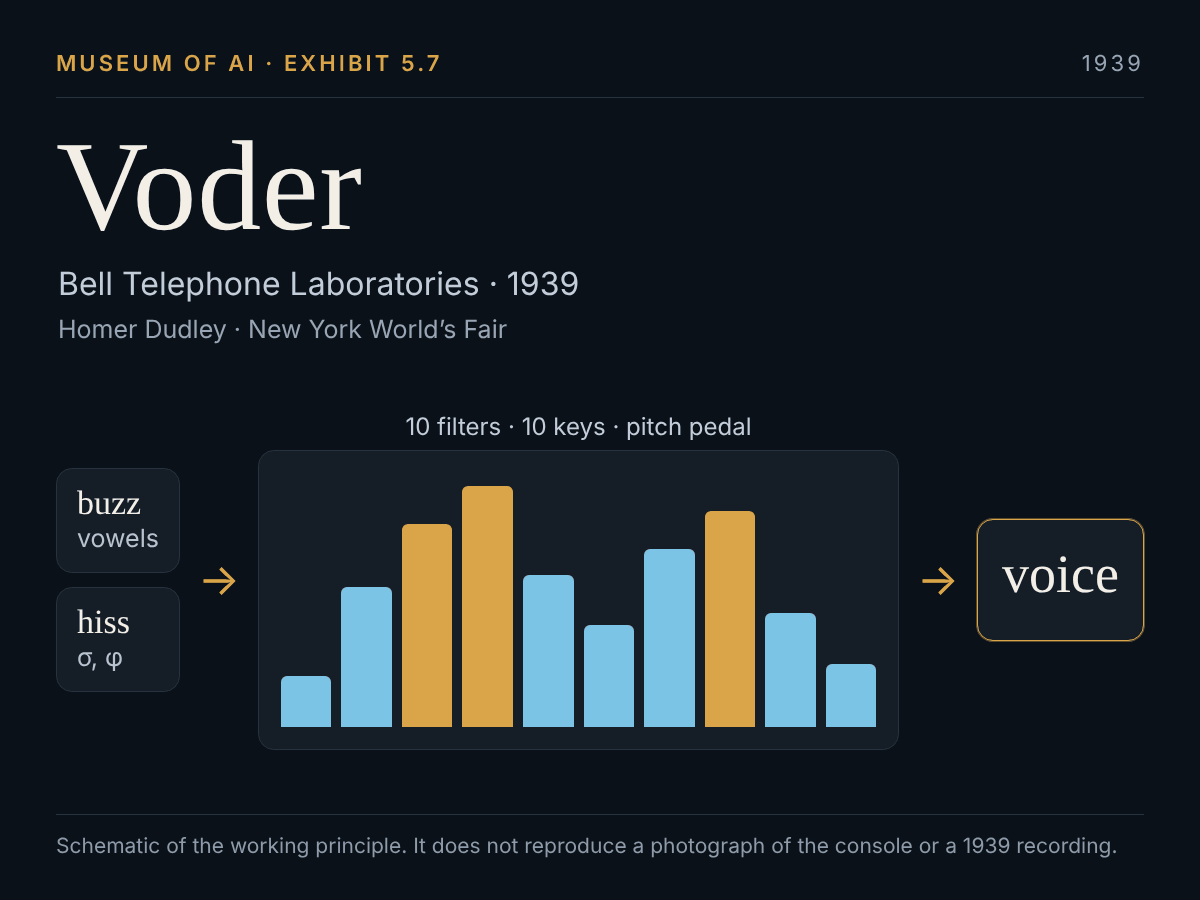
The museum graphic explains the Voder’s operating principle. It is retained as interpretation, not as the primary historical object.
Independent Digital Museum of Artificial Intelligence · educational reconstruction · supporting interpretation, 2026.
Why it is in the museum
Language is treated as a prediction problem. From Shannon’s statistical sequences, the story leads to Transformers and large language models.
The story of the exhibit
The Voder, short for Voice Operation DEmonstratoR, was built at Bell Telephone Laboratories by the engineer Homer Dudley together with Robert Riesz. It was shown in 1939 at the World’s Fairs in New York and San Francisco. It rested on the idea behind the vocoder, which Dudley had been developing since the late 1920s: speech can be described as a sound source passing through filters, just as the sound of the vocal folds passes through the mouth and nose.
With a wrist bar, the operator chose between two sources: a periodic buzz for vowels and a hiss of noise for sounds such as “s”. Ten keys, one for each finger, controlled ten frequency filters. A pedal changed the pitch of the voice, and three extra keys produced the short bursts of stop consonants such as “p” or “t”. Speaking intelligibly took about a year of training, and even then many sounds were hard to understand.
The idea of a talking machine was not new. Wolfgang von Kempelen, who built the Mechanical Turk, had described a speaking machine with bellows and a reed in 1791. The Voder, however, was electrical and based on an analysis of sound into frequencies. Vocoder technology was later used in SIGSALY, the encrypted telephone system of the Second World War.
Play the Voder
The simulation follows the Voder’s principle: a sound source, ten filters and a pedal for pitch. The filter frequencies are approximate and do not copy the 1939 values. You will hear vowels rather than clear words, which shows how hard the operator’s job was.
Sound source
Filter keys
Pitch pedal
Stop consonants
Preset vowels
Hold the keys down with the mouse, a finger or the keyboard (A S D F G H J K L ;). On the keyboard, hold Space for hiss. Arrow keys up and down.
Sound stays off until you turn it on. The simulation is not a recording of the Voder.
Evidence and interpretation
Its construction by Bell Labs, the public demonstrations of 1939 and its basic working principle are documented. The technical basis is described in Dudley’s US Patent 2,121,142, filed in 1937 and granted on 21 June 1938.
The Voder was not a text-to-speech system. It did not read and did not decide what to say. All the linguistic knowledge was in the operator’s hands, as she translated each word into movements. The Independent Digital Museum of Artificial Intelligence shows it in the room on language for this distinction. Today’s speech synthesisers and language models have moved much of that work inside the machine, which is why the question “who is speaking?” has become harder.
What supports this exhibit
Primary technical document (patent)
The technical principle of producing a voice artificially with a sound source and filters, on which the Voder was based.
Main source: Dudley, H. W. (1938), “System for the artificial production of vocal or other sounds”, US Patent 2,121,142, Bell Telephone Laboratories. Filed 7 April 1937, granted 21 June 1938.
What to keep in mind: The patent describes the technique, not the 1939 demonstrations, which are documented by secondary sources. The interactive on this page is a simplified simulation.
Full documentation
What we know and how certain it is
Documented
The 1939 paper by Dudley, Riesz and Watkins describes the Voder as an electrical device for producing synthetic vocal sounds.
The visual does not imply that the machine could understand speech autonomously.
Provenance and rights
A citation to scientific work does not confer an image-reuse licence. Earlier image credits remain, without claiming a new rights audit.
AI conversation
The exhibit chat is a separate AI service. The live model version and expert review of each generated answer have not been verified. Sources do not guarantee correctness.
Limits of this review
Selected-claim curatorial review on 30 October 2026. No independent scientific or legal certification was undertaken.
Permanent accession ID
MTN-0072
Exhibition position
5.7
Title
The Voder: a voice from electrical circuits
Date
1939
Creator / responsible institution
Homer Dudley (1896–1980) and Robert Riesz, Bell Telephone Laboratories
Evidence type
Primary technical document (patent)
Original / reproduction status
Curatorial diagram of the Voder operating principle
Provenance / custody history
The Independent Digital Museum of Artificial Intelligence documents the published source and claims no ownership of an original object.
Primary documentary source
Dudley, H. W. (1938), “System for the artificial production of vocal or other sounds”, US Patent 2,121,142, Bell Telephone Laboratories. Filed 7 April 1937, granted 21 June 1938.
Image rights
Original museum schematic · /assets/voder-signal-path-museum-v881923.svg · Archival photograph linked as source: https://commons.wikimedia.org/wiki/File:VODER_demonstrated_on_1939_New_York_World_Fair_-_The_VODER_fascinates_the_crowds_-_Bell_Telephone_Quarterly_(January_1940).jpg
Linked to: 5.6 ChatGPT: the voice without language of 1939 and the conversational interface of 2022
This record separates the evidence from its visual representation and records provenance, rights and curatorial relationships.
Citation & editorial transparency
Suggested citation
Independent Digital Museum of Artificial Intelligence. (2026). “The Voder: a voice from electrical circuits”. https://www.mouseiotn.eu/en/exhibits/the-voder-a-voice-from-circuits/
The suggested questions open curated extracts. You can also submit a question when the live service is available.
The exhibit’s “voice” is a curatorial reconstruction, not an authentic statement or actual consciousness. Documented fact, interpretation, reconstruction and uncertainty remain distinct.
Preset questions use the exhibit record in your browser. If you submit a free-text question, its text, the exhibit ID and language go to the museum API and may be forwarded to an external AI provider. Answers can contain errors. Do not enter personal information. Privacy.